A simple tracker for your class. Practice Statements down the left, ten student-name spaces across the top, and blank cells to use your way.
Choose a strand below. Write in the names, then add your own ticks, dates, codes or notes. For a class of 25, print three copies of the tracker.
75 Practice Statements · 7 strands · PDF and Google Sheets · No TeacherGPT signup needed
Choose a tracker by strand
Each preview shows the first page of that PDF. Longer strands continue over several pages, with space for the same ten names on every page.
Prefer to work online? Choose Copy to Google Sheets to make your own editable copy in your Google account. The original is view-only. Add student names and notes to your own copy, and add more student columns if needed.
In the Number PDF, each curriculum subcategory starts on a new page. Longer subcategories continue under the same heading.
Algebra
10 Practice Statements · 1 page · 10 student columns
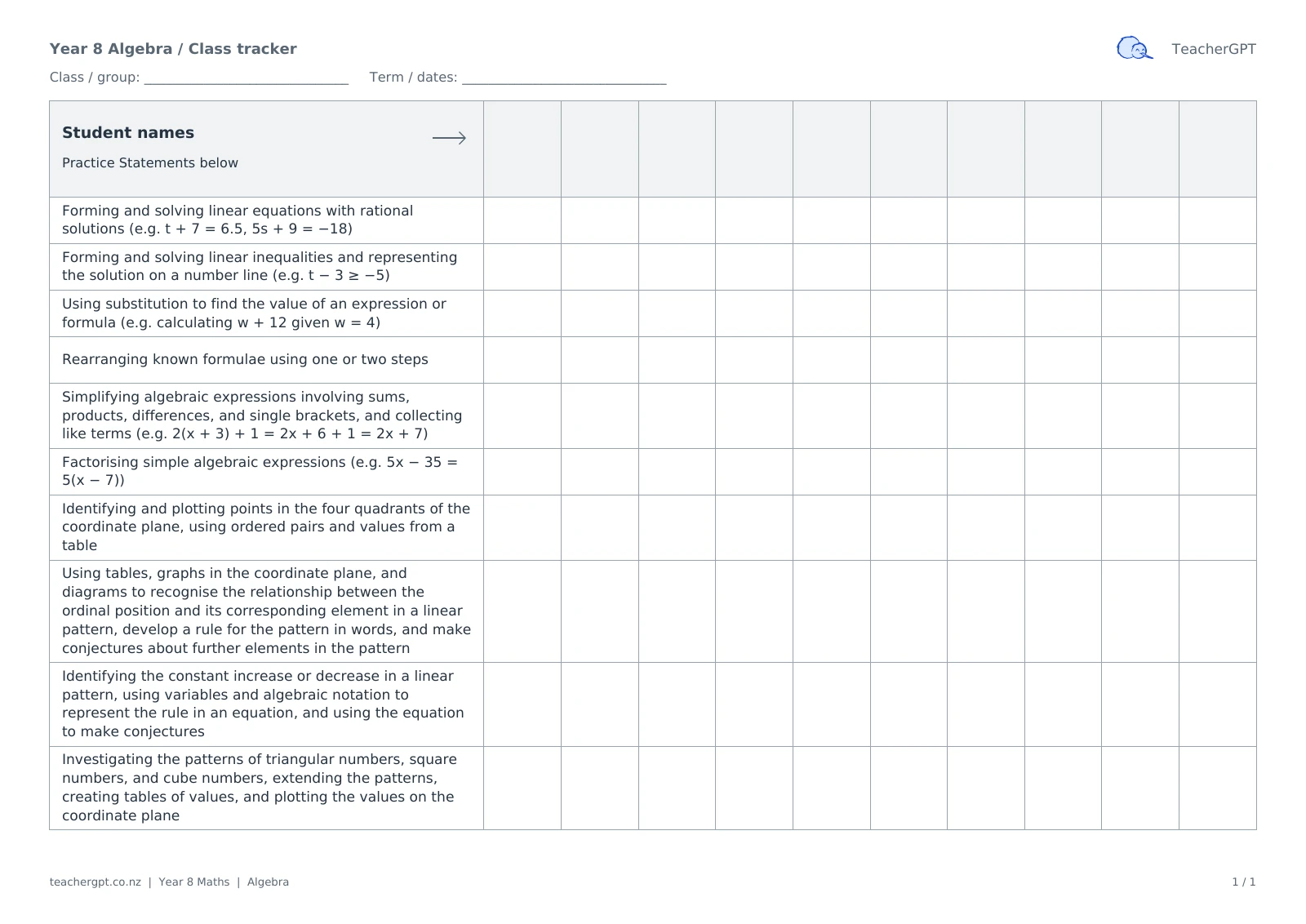
Identifying and plotting points in the four quadrants of the coordinate plane, using ordered pairs and values from a table
Using tables, graphs in the coordinate plane, and diagrams to recognise the relationship between the ordinal position and its corresponding element in a linear pattern, develop a rule for the pattern in words, and make conjectures about further elements in the pattern
Identifying the constant increase or decrease in a linear pattern, using variables and algebraic notation to represent the rule in an equation, and using the equation to make conjectures
Investigating the patterns of triangular numbers, square numbers, and cube numbers, extending the patterns, creating tables of values, and plotting the values on the coordinate plane
Geometry
Pathways
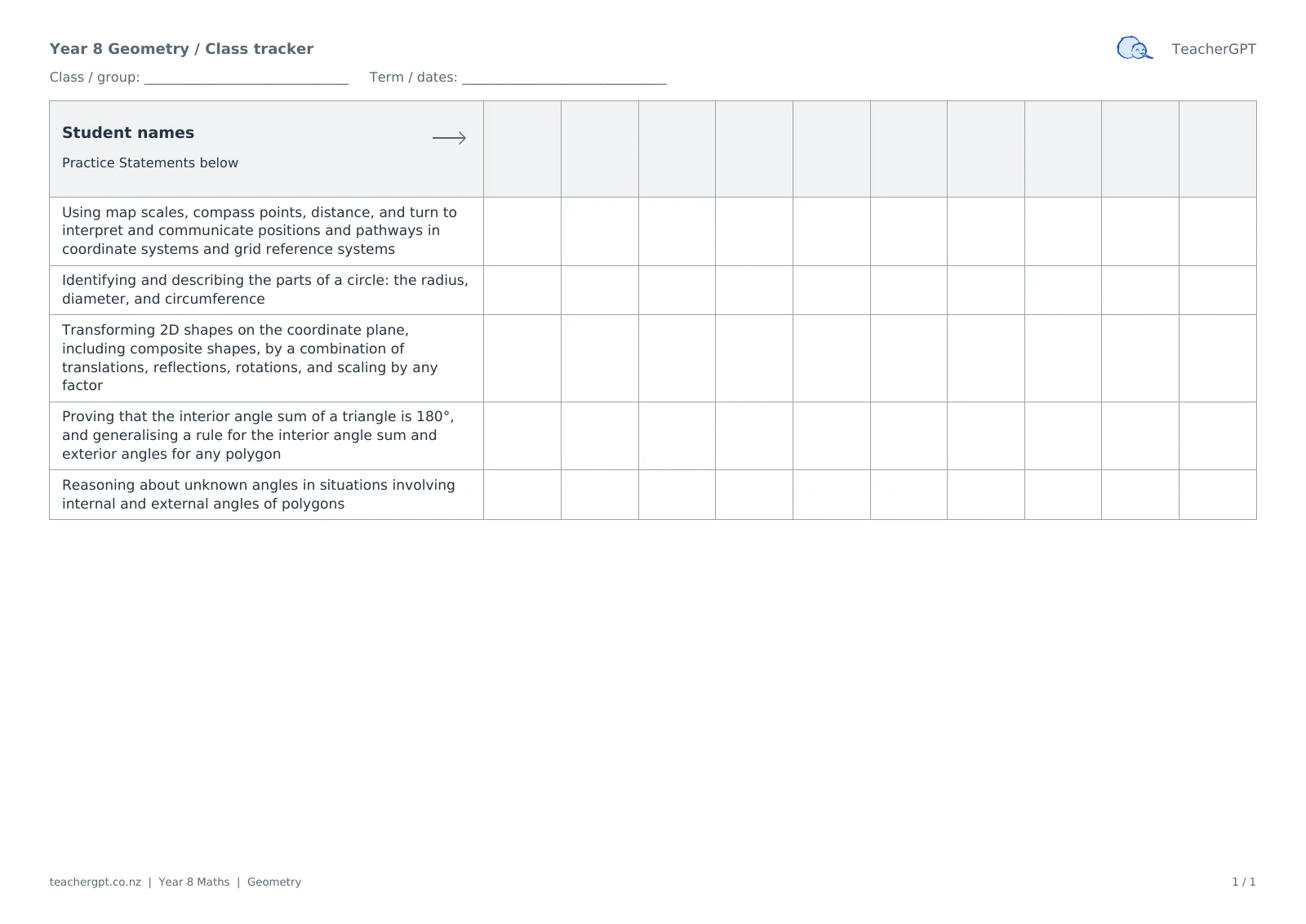
Using map scales, compass points, distance, and turn to interpret and communicate positions and pathways in coordinate systems and grid reference systems
Shapes
Identifying and describing the parts of a circle: the radius, diameter, and circumference
Spatial reasoning
Transforming 2D shapes on the coordinate plane, including composite shapes, by a combination of translations, reflections, rotations, and scaling by any factor
Proving that the interior angle sum of a triangle is 180°, and generalising a rule for the interior angle sum and exterior angles for any polygon
Reasoning about unknown angles in situations involving internal and external angles of polygons
The language of Mathematics and Statistics
Algebra
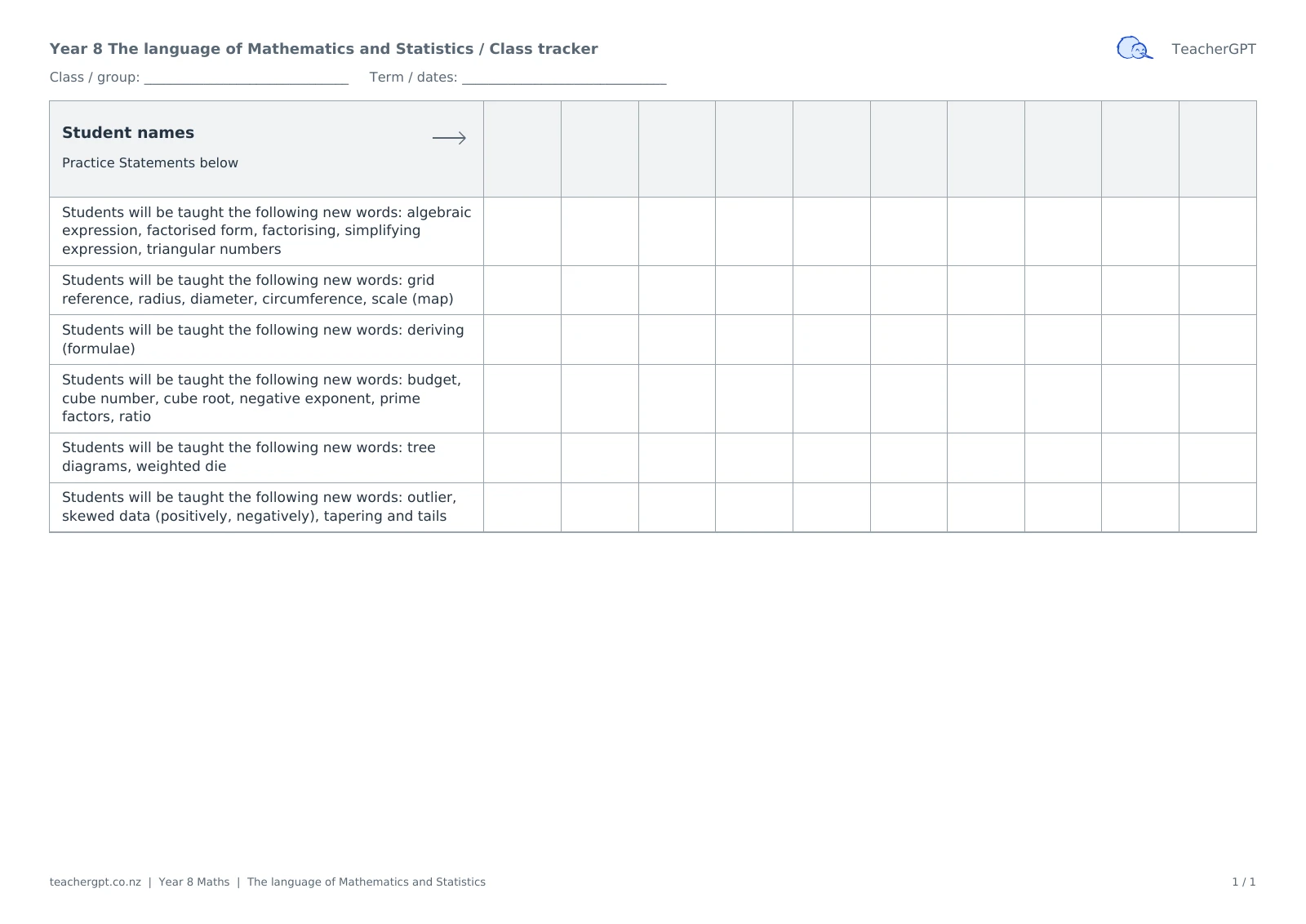
Students will be taught the following new words: algebraic expression, factorised form, factorising, simplifying expression, triangular numbers
Geometry
Students will be taught the following new words: grid reference, radius, diameter, circumference, scale (map)
Measurement
Students will be taught the following new words: deriving (formulae)
Number
Students will be taught the following new words: budget, cube number, cube root, negative exponent, prime factors, ratio
Probability
Students will be taught the following new words: tree diagrams, weighted die
Statistics
Students will be taught the following new words: outlier, skewed data (positively, negatively), tapering and tails
Measurement
Measuring
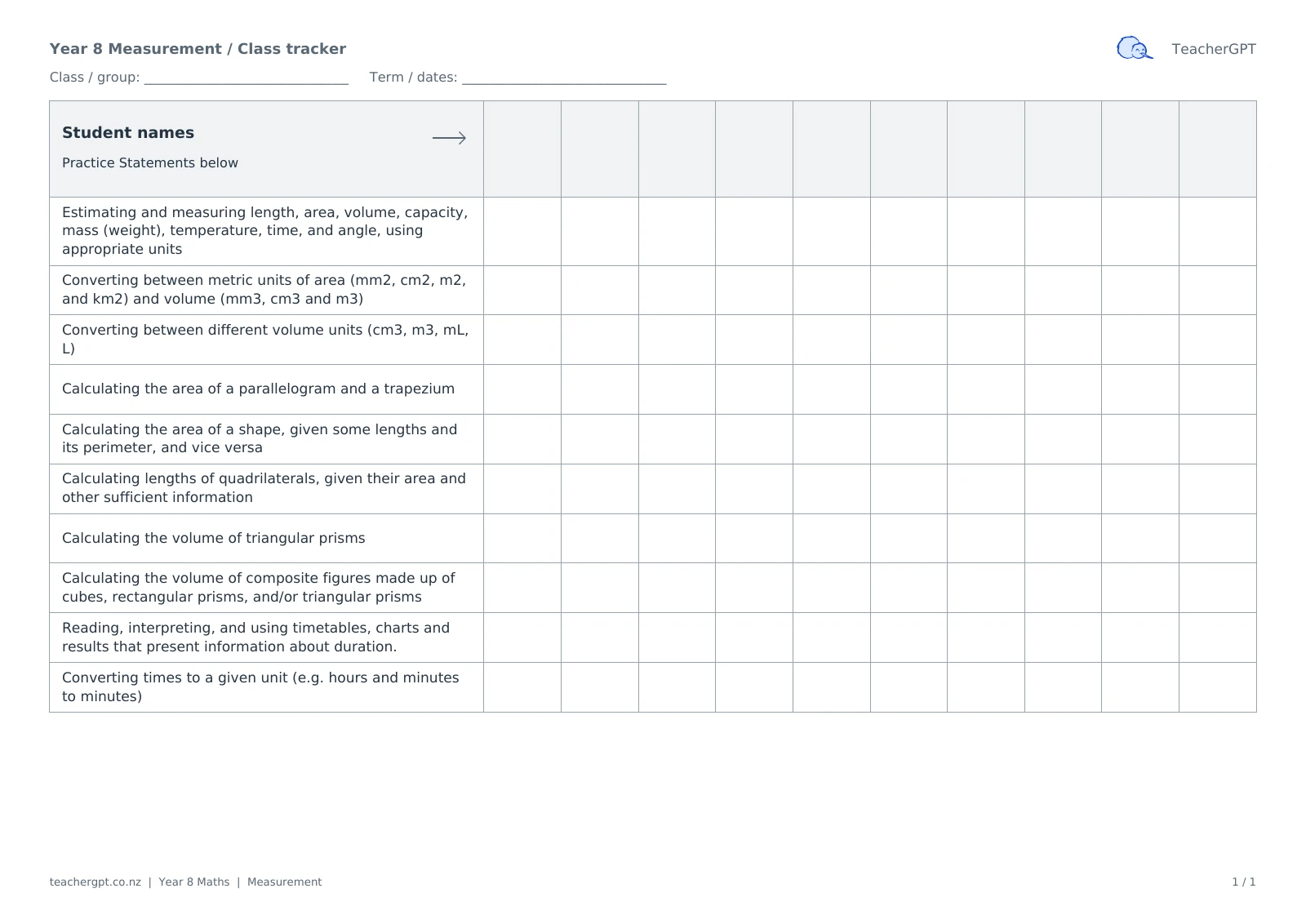
Estimating and measuring length, area, volume, capacity, mass (weight), temperature, time, and angle, using appropriate units
Converting between metric units of area (mm2, cm2, m2, and km2) and volume (mm3, cm3 and m3)
Converting between different volume units (cm3, m3, mL, L)
Calculating the area of a parallelogram and a trapezium
Calculating the area of a shape, given some lengths and its perimeter, and vice versa
Calculating lengths of quadrilaterals, given their area and other sufficient information
Calculating the volume of triangular prisms
Calculating the volume of composite figures made up of cubes, rectangular prisms, and/or triangular prisms
Reading, interpreting, and using timetables, charts and results that present information about duration.
Converting times to a given unit (e.g. hours and minutes to minutes)
Number
Financial mathematics
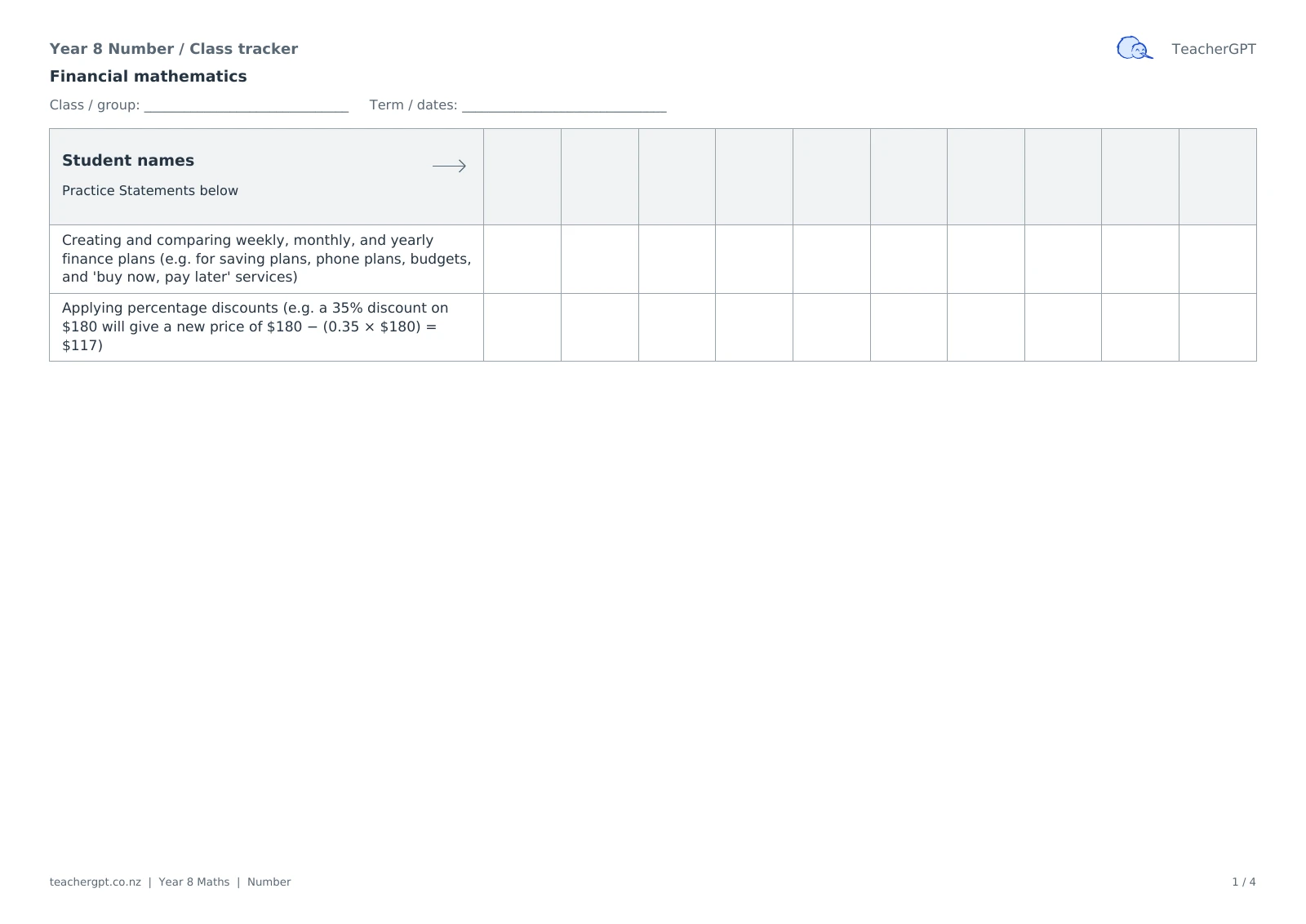
Creating and comparing weekly, monthly, and yearly finance plans (e.g. for saving plans, phone plans, budgets, and 'buy now, pay later' services)
Applying percentage discounts (e.g. a 35% discount on $180 will give a new price of $180 − (0.35 × $180) = $117)
Number structures and operations
Reading, writing comparing, and ordering whole numbers and decimals using positive and negative powers of 10
Representing whole numbers and decimals in expanded form using powers of 10 (e.g. 3.61 = 3 × 10^0 + 6 × 10^−1 + 1 × 10^−2)
Representing negative powers of 10 as a fraction and a decimal, and vice-versa (e.g. 0.01 = 1/100 = 10^−2)
Using exponents and identifying cube roots for cube numbers up to at least 125
Using radicals (√ and 3√) to represent square and cube roots
Evaluating square and cube roots for perfect squares and cubes and using a calculator to approximate them for other numbers
Representing composite numbers as products of their prime factors, using exponents to summarise repeated factors (e.g. 36 = 2 × 2 × 3 × 3 = 2^2 × 3^2)
Locating negative and positive numbers on a number line
Comparing and ordering negative and positive numbers using a number line (e.g. −3.4 < −3)
Using rounding, estimation, and benchmarks to predict results and to check the reasonableness of calculations (e.g. 14.7 × 5 must be between 14 × 5 = 70 and 15 × 5 = 75)
Rounding whole numbers to any specified power of 10, and rounding decimals to the nearest whole number, tenth, hundredth, or thousandth
Multiplying and dividing whole numbers (e.g. 327 ÷ 15 = 21.8 or 21 4/5)
Evaluating expressions with integers, using the order of operations
Identifying, reading, writing, and representing fractions, decimals, and percentages
Comparing, ordering, and converting between fractions, decimals, and percentages
Multiplying whole numbers by fractions, including by improper fractions, by mixed numbers, and by first converting to an improper fraction
Multiplying fractions and representing the answer in its simplest form
Multiplying and dividing numbers by powers of 10
Multiplying positive decimals (e.g. 2.3 × 45)
Finding a fraction of a whole number, including when the result is a mixed number or improper fraction (e.g. for 2/5 of 42, 2/5 × 42 = 84/5 = 164/5 )
Finding a whole amount when given a fraction, including when the whole set is a mixed number or improper fraction (e.g. if 8 is 3/5 of a set, 8 × 5/3 = 13 1/3 )
Finding percentages of whole numbers
Finding the whole (100%) when given a percentage (e.g. 3% is 27)
Identifying percentage equivalence in calculations (e.g. 45% of 20 is equal to 20% of 45)
Dividing a quantity into two parts, given the part:part or part:whole ratio
Expressing the division of quantity into two parts as a ratio
Probability
Experimental probability
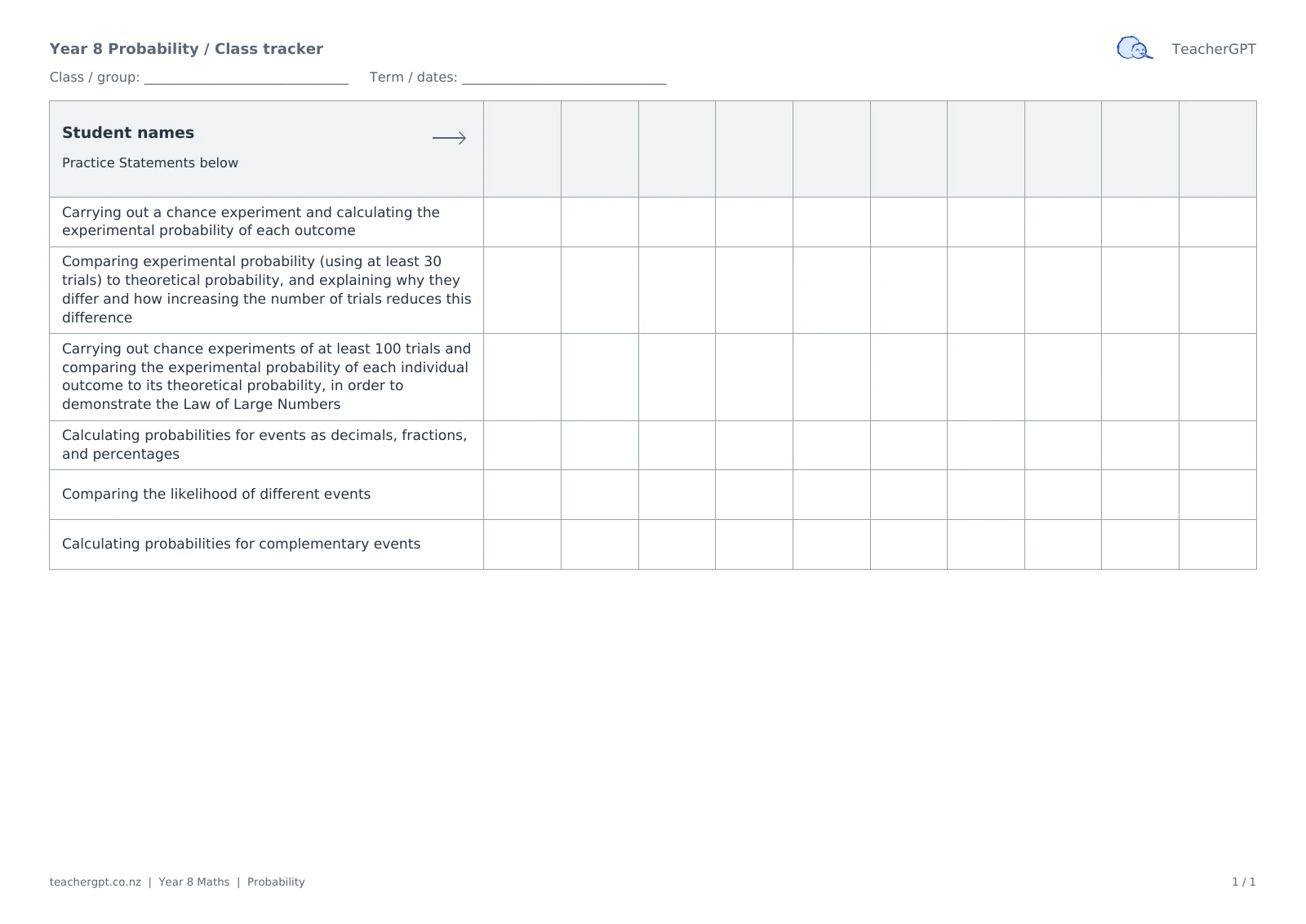
Carrying out a chance experiment and calculating the experimental probability of each outcome
Comparing experimental probability (using at least 30 trials) to theoretical probability, and explaining why they differ and how increasing the number of trials reduces this difference
Carrying out chance experiments of at least 100 trials and comparing the experimental probability of each individual outcome to its theoretical probability, in order to demonstrate the Law of Large Numbers
Theoretical probability
Calculating probabilities for events as decimals, fractions, and percentages
Comparing the likelihood of different events
Calculating probabilities for complementary events
Statistics
Developing knowledge from data
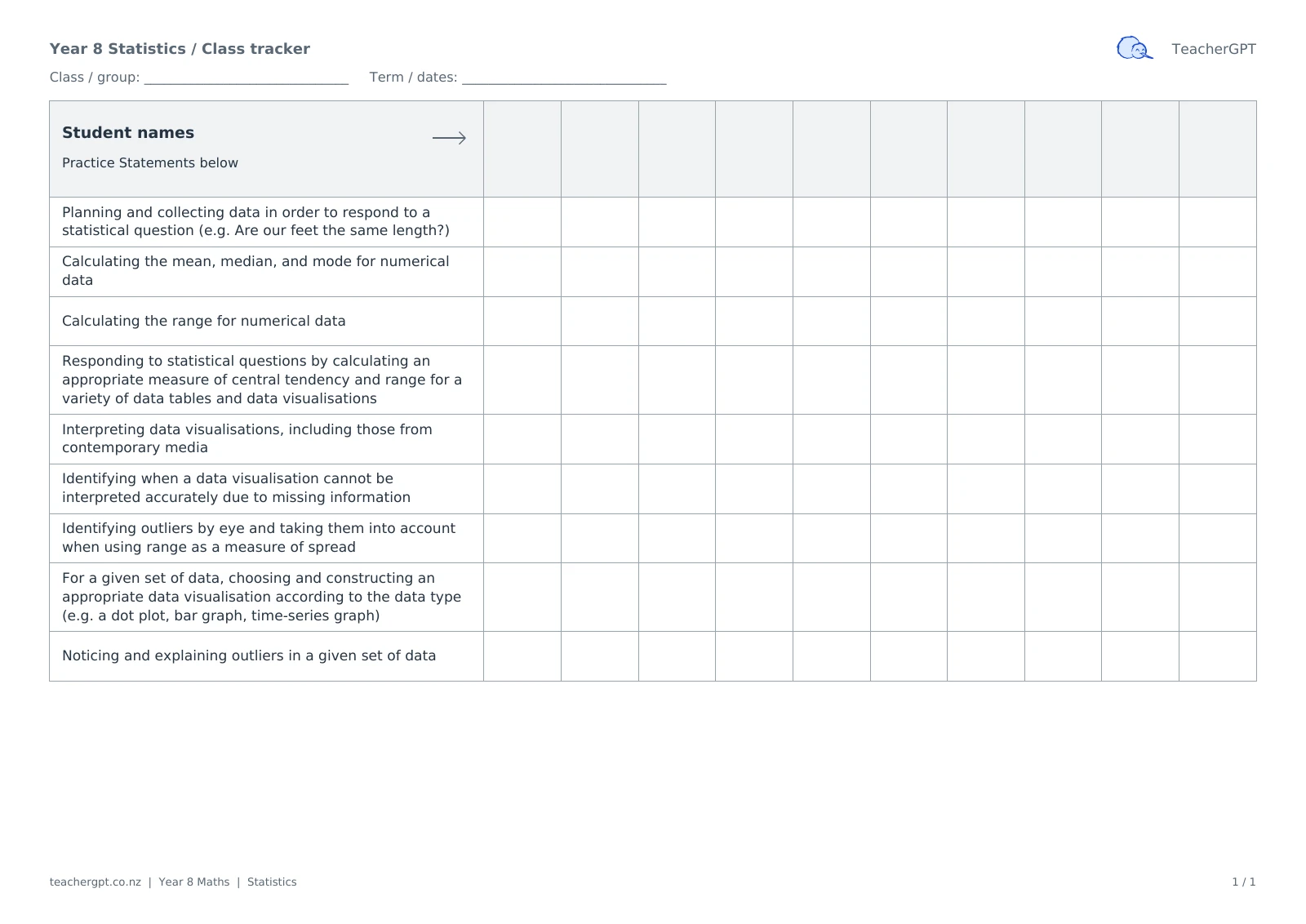
Planning and collecting data in order to respond to a statistical question (e.g. Are our feet the same length?)
Calculating the mean, median, and mode for numerical data
Calculating the range for numerical data
Interpretation of data
Responding to statistical questions by calculating an appropriate measure of central tendency and range for a variety of data tables and data visualisations
Interpreting data visualisations, including those from contemporary media
Identifying when a data visualisation cannot be interpreted accurately due to missing information
Identifying outliers by eye and taking them into account when using range as a measure of spread
Visualisation of data
For a given set of data, choosing and constructing an appropriate data visualisation according to the data type (e.g. a dot plot, bar graph, time-series graph)
Noticing and explaining outliers in a given set of data