A simple tracker for your class. Practice Statements down the left, ten student-name spaces across the top, and blank cells to use your way.
Choose a strand below. Write in the names, then add your own ticks, dates, codes or notes. For a class of 25, print three copies of the tracker.
44 Practice Statements · 6 strands · PDF and Google Sheets · No TeacherGPT signup needed
Choose a tracker by strand
Each preview shows the first page of that PDF. Longer strands continue over several pages, with space for the same ten names on every page.
Prefer to work online? Choose Copy to Google Sheets to make your own editable copy in your Google account. The original is view-only. Add student names and notes to your own copy, and add more student columns if needed.
In the Number PDF, each curriculum subcategory starts on a new page. Longer subcategories continue under the same heading.
Algebra
4 Practice Statements · 1 page · 10 student columns
These trackers cover all 44 stored Year 1 Maths Practice Statements, organised into their curriculum strands and skill groups.
Algebra
Equations and relationships
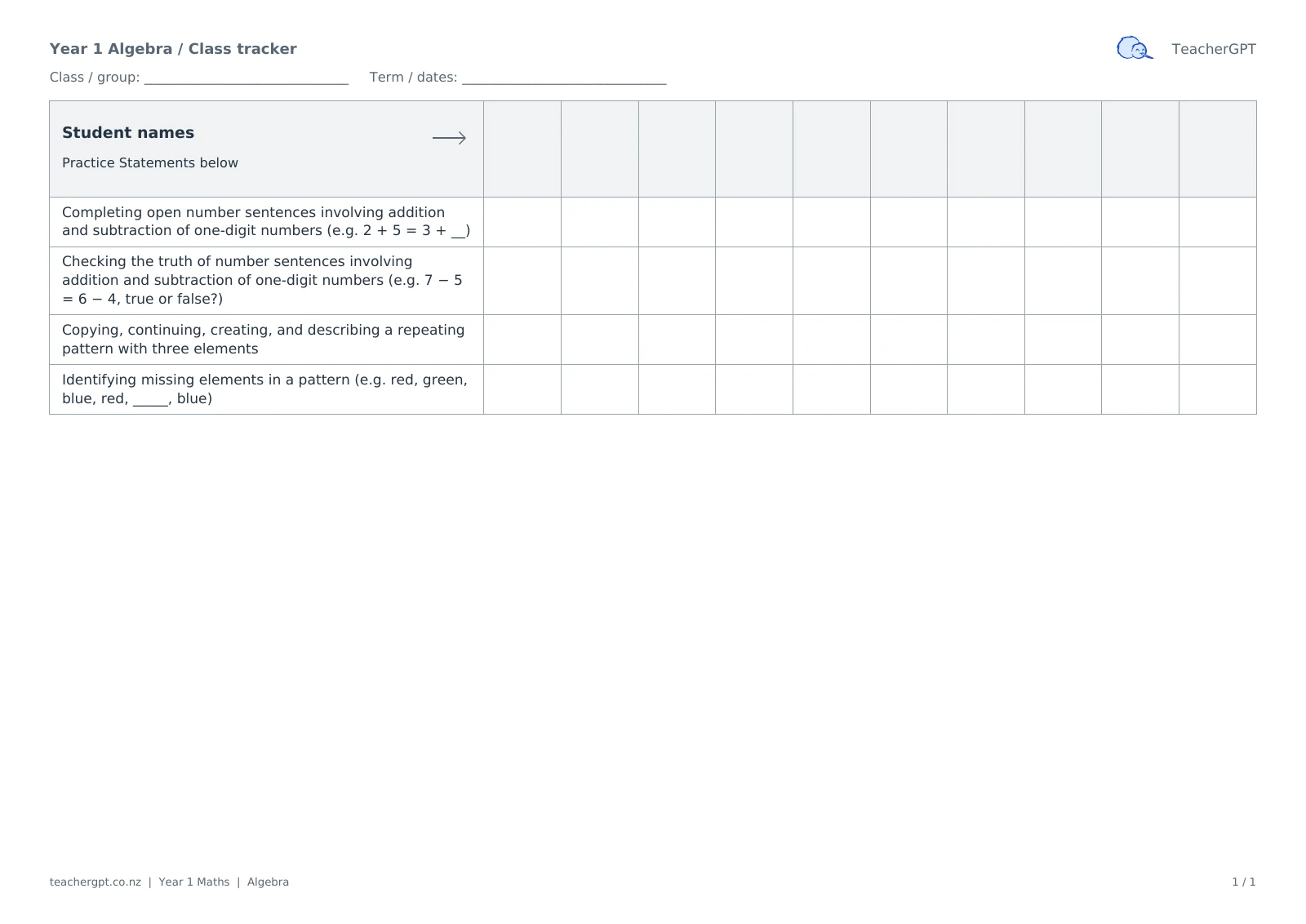
Completing open number sentences involving addition and subtraction of one-digit numbers (e.g. 2 + 5 = 3 + __)
Checking the truth of number sentences involving addition and subtraction of one-digit numbers (e.g. 7 − 5 = 6 − 4, true or false?)
Copying, continuing, creating, and describing a repeating pattern with three elements
Identifying missing elements in a pattern (e.g. red, green, blue, red, _____, blue)
Geometry
Pathways
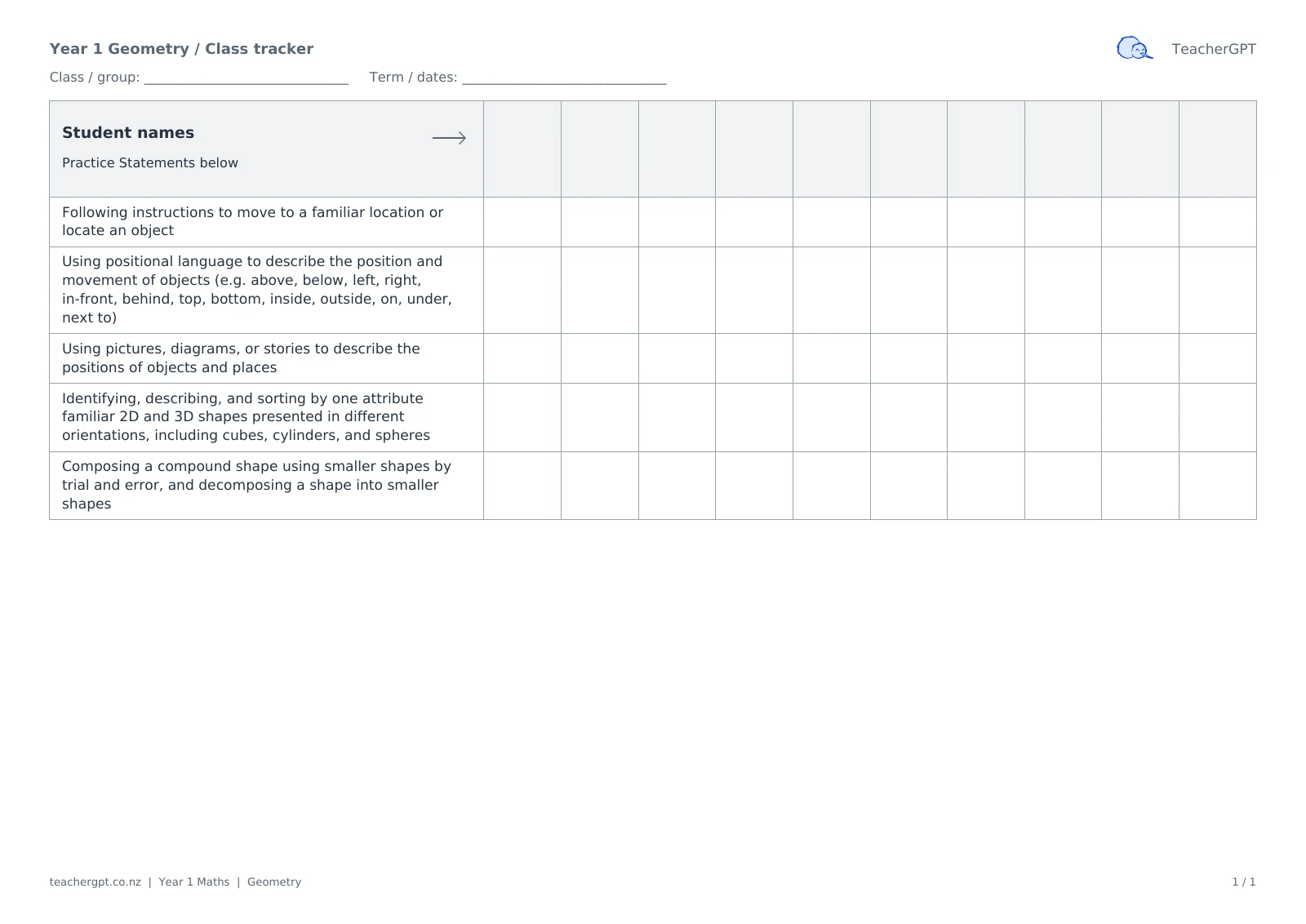
Following instructions to move to a familiar location or locate an object
Using positional language to describe the position and movement of objects (e.g. above, below, left, right, in-front, behind, top, bottom, inside, outside, on, under, next to)
Using pictures, diagrams, or stories to describe the positions of objects and places
Shapes
Identifying, describing, and sorting by one attribute familiar 2D and 3D shapes presented in different orientations, including cubes, cylinders, and spheres
Spatial reasoning
Composing a compound shape using smaller shapes by trial and error, and decomposing a shape into smaller shapes
The language of Mathematics and Statistics
Algebra
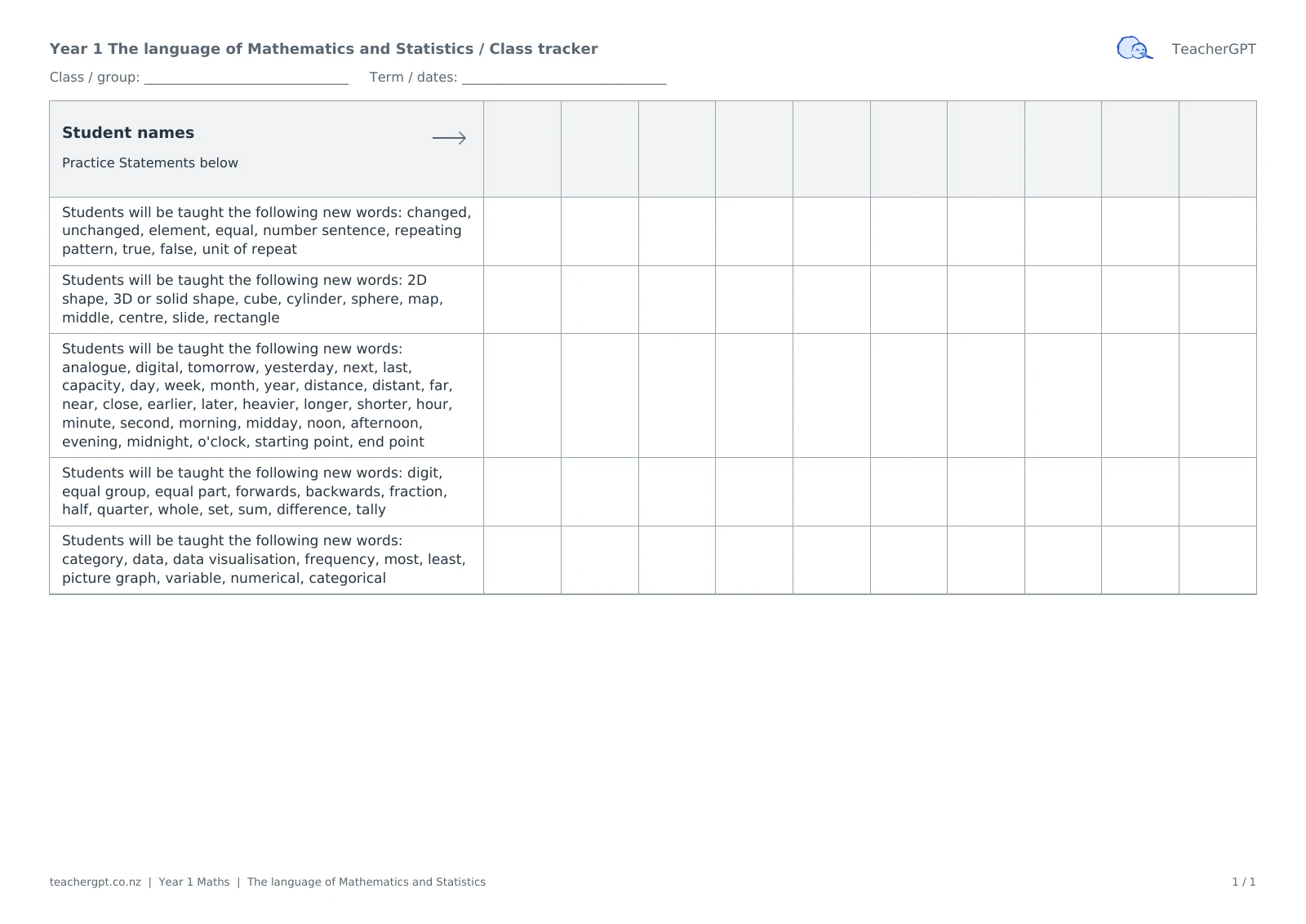
Students will be taught the following new words: changed, unchanged, element, equal, number sentence, repeating pattern, true, false, unit of repeat
Geometry
Students will be taught the following new words: 2D shape, 3D or solid shape, cube, cylinder, sphere, map, middle, centre, slide, rectangle
Measurement
Students will be taught the following new words: analogue, digital, tomorrow, yesterday, next, last, capacity, day, week, month, year, distance, distant, far, near, close, earlier, later, heavier, longer, shorter, hour, minute, second, morning, midday, noon, afternoon, evening, midnight, o'clock, starting point, end point
Number
Students will be taught the following new words: digit, equal group, equal part, forwards, backwards, fraction, half, quarter, whole, set, sum, difference, tally
Statistics
Students will be taught the following new words: category, data, data visualisation, frequency, most, least, picture graph, variable, numerical, categorical
Measurement
Measuring
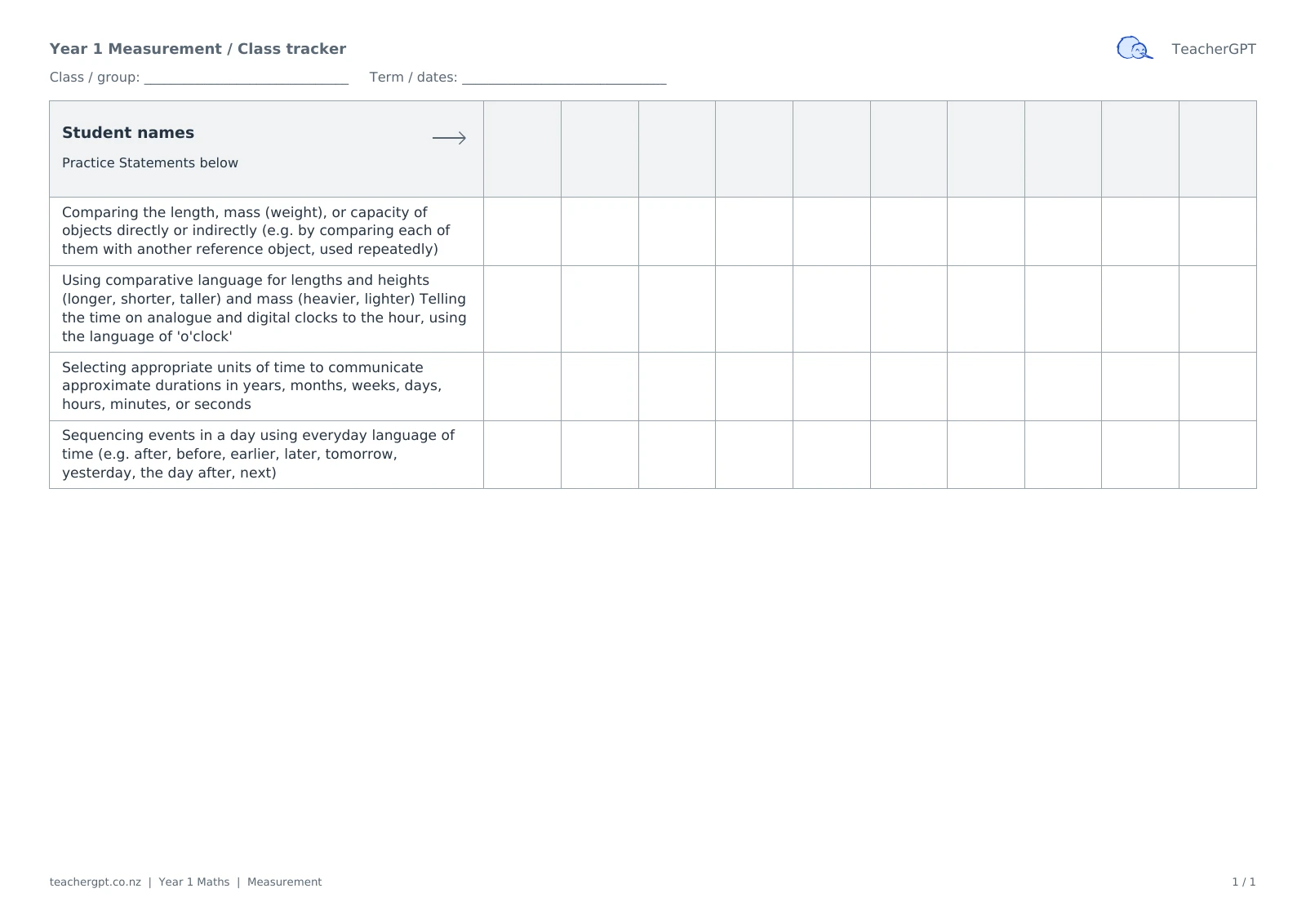
Comparing the length, mass (weight), or capacity of objects directly or indirectly (e.g. by comparing each of them with another reference object, used repeatedly)
Using comparative language for lengths and heights (longer, shorter, taller) and mass (heavier, lighter) Telling the time on analogue and digital clocks to the hour, using the language of 'o'clock'
Selecting appropriate units of time to communicate approximate durations in years, months, weeks, days, hours, minutes, or seconds
Sequencing events in a day using everyday language of time (e.g. after, before, earlier, later, tomorrow, yesterday, the day after, next)
Number
Financial mathematics
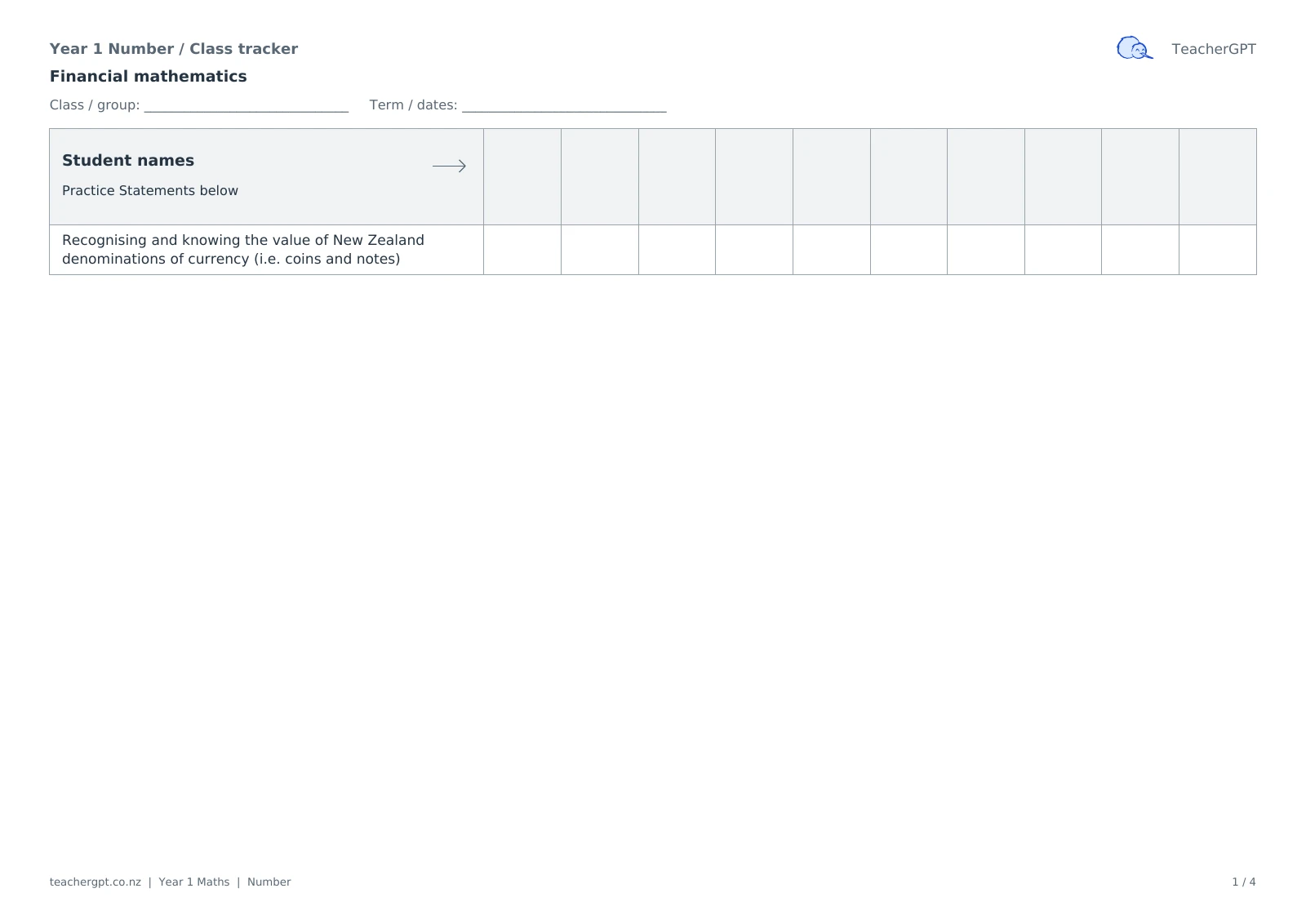
Recognising and knowing the value of New Zealand denominations of currency (i.e. coins and notes)
Number structures
Reading and writing whole numbers up to 100, and representing them using base 10 structure
Counting forwards or backwards from any whole number between 1 and 20, and then between 1 and 100
Comparing and ordering whole numbers and ordinal numbers using representations, words, or numerals, and suffixes to 100
Using te reo Māori for numbers up to 30
Locating numbers on a partially labelled number line (e.g. 17 on a number line labelled in 5s)
Subitising (recognising without counting) smaller groups of objects within a larger collection (e.g. 3 and 5 in a group of 8 objects)
Counting collections of objects using one-to-one correspondence, and then by pairs, for up to 20 objects
Finding the total number of objects up to 20 by grouping (using pairs, 5s, or 10s)
Counting forwards and backwards in 2s and 10s from any whole number between 0 and 100
Operations
Memorising addition and subtraction facts up to 10, including 10 + 0 = 10 (e.g. 7 + 3 = 10)
Memorising doubles and halves to 10
Naming the number before or after a given number in the counting sequence up to 20
Adding and subtracting one- and two-digit numbers up to 20, including 0
Joining and separating groups of up to 20 objects (e.g. 9 + 6, 7 + __ = 11)
Adding ten to a one-digit number
Solving one-step problems involving addition and subtraction using objects and pictorial representations
Multiplying and dividing using equal grouping or counting for products and dividends within 20
Rational numbers
Recognising and representing halves and quarters as fractions of sets, quantities, and regions, using equal parts of the whole
Finding a half or quarter of a set using equal sharing and grouping
Connecting 1/2 and 1/4 through halving
Statistics
Developing knowledge from data
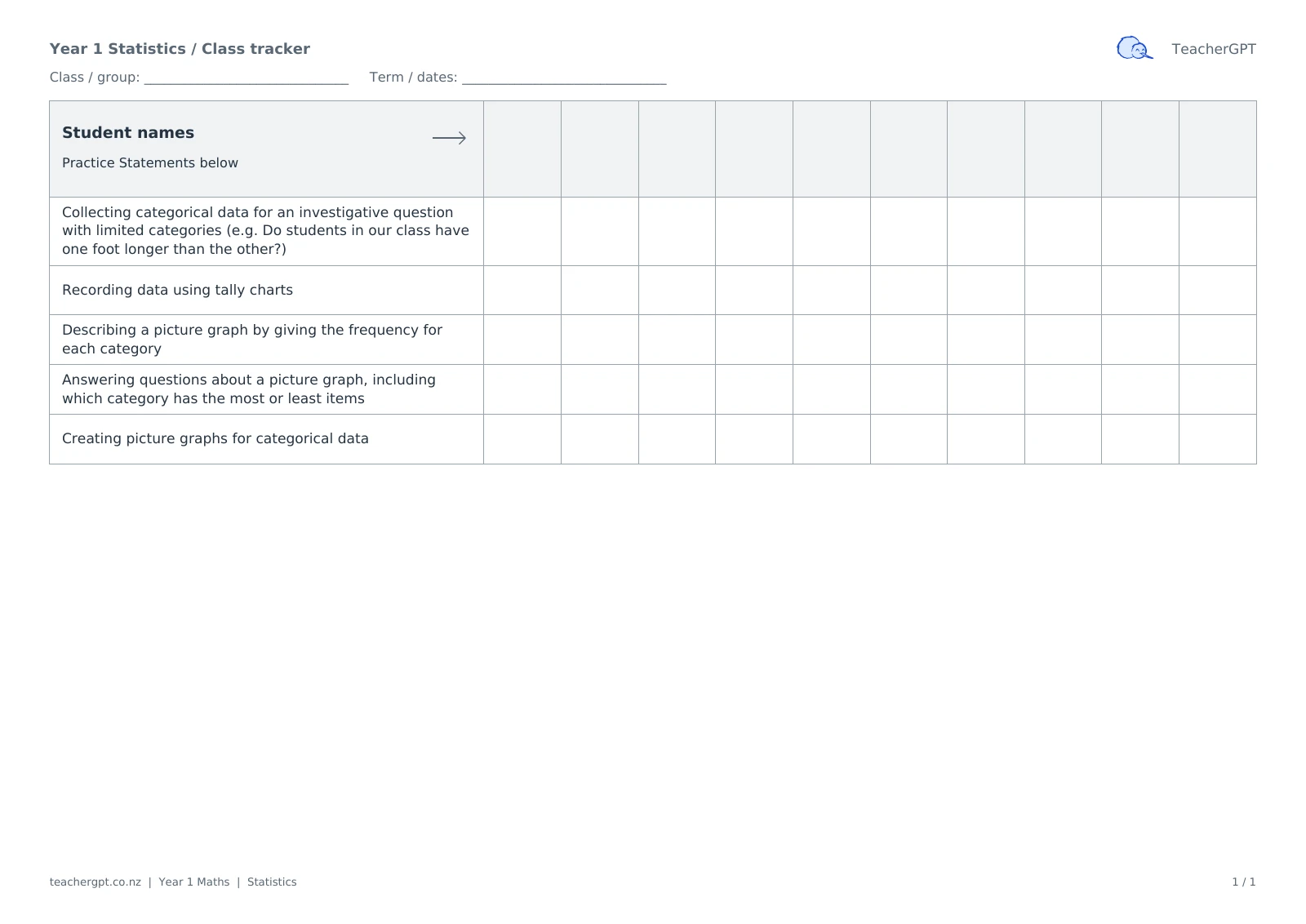
Collecting categorical data for an investigative question with limited categories (e.g. Do students in our class have one foot longer than the other?)
Recording data using tally charts
Interpretation of data
Describing a picture graph by giving the frequency for each category
Answering questions about a picture graph, including which category has the most or least items