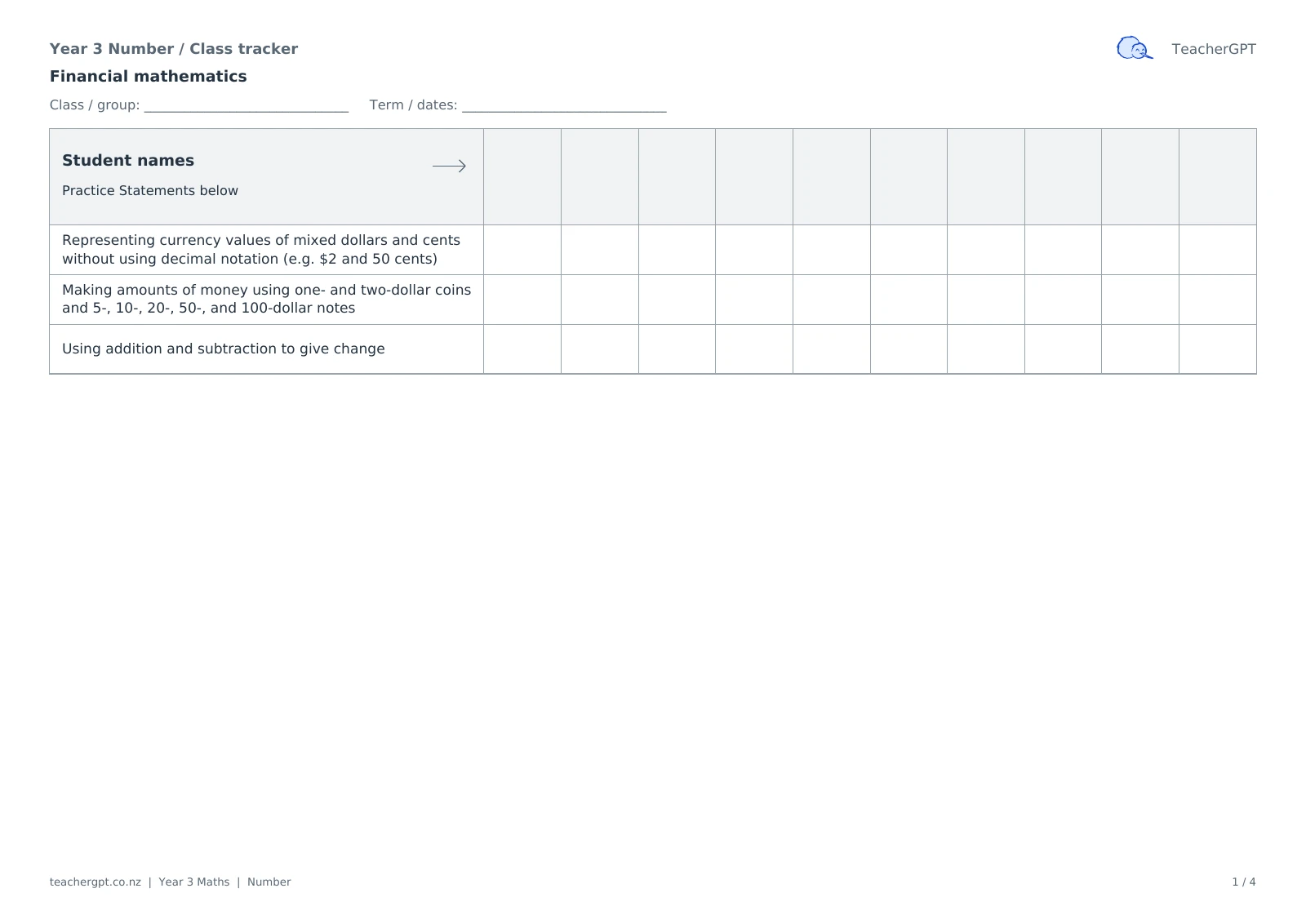
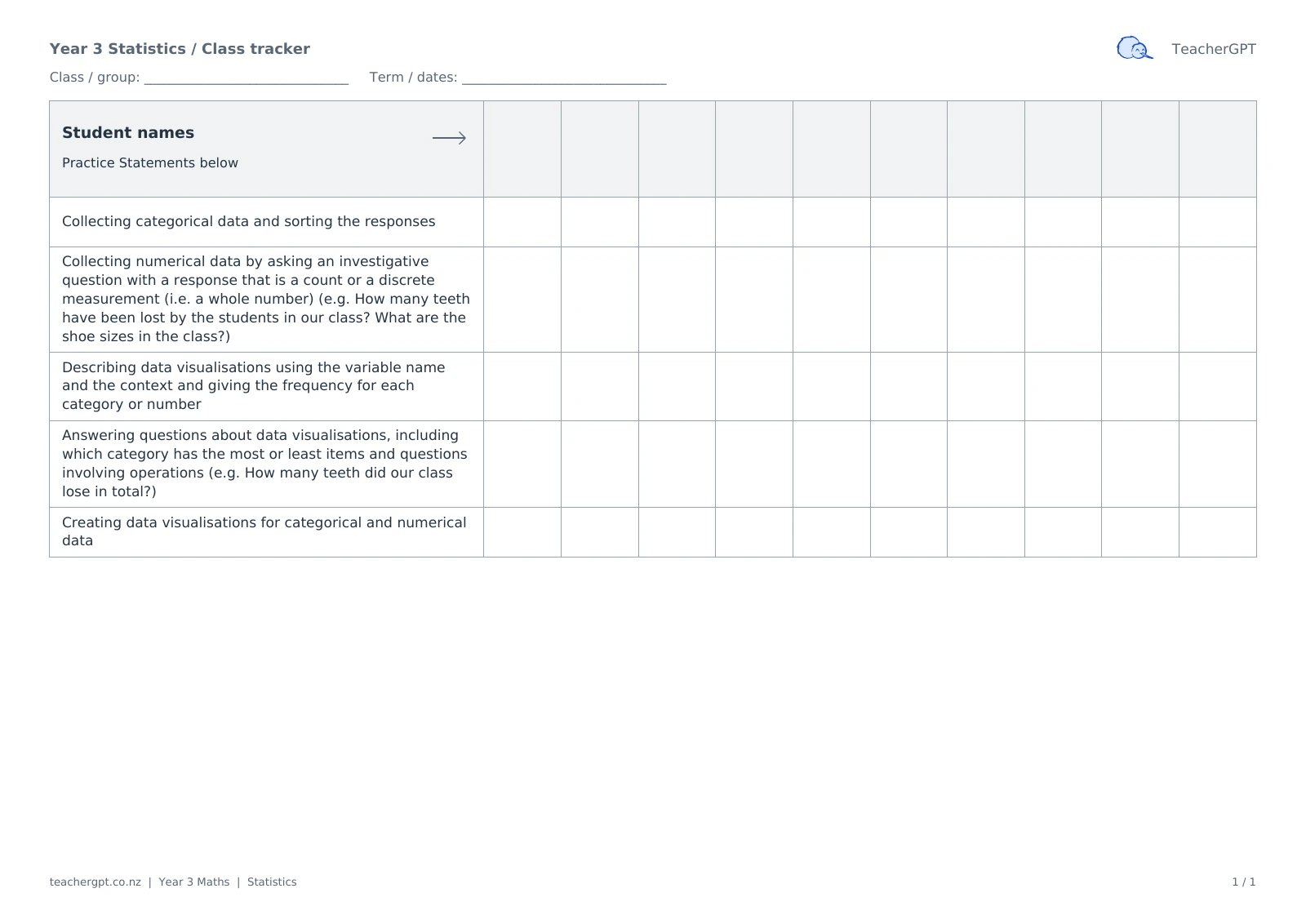
A simple tracker for your class. Practice Statements down the left, ten student-name spaces across the top, and blank cells to use your way.
Choose a strand below. Write in the names, then add your own ticks, dates, codes or notes. For a class of 25, print three copies of the tracker.
52 Practice Statements · 6 strands · PDF and Google Sheets · No TeacherGPT signup needed
Choose a tracker by strand
Each preview shows the first page of that PDF. Longer strands continue over several pages, with space for the same ten names on every page.
Prefer to work online? Choose Copy to Google Sheets to make your own editable copy in your Google account. The original is view-only. Add student names and notes to your own copy, and add more student columns if needed.
In the Number PDF, each curriculum subcategory starts on a new page. Longer subcategories continue under the same heading.
Algebra
3 Practice Statements · 1 page · 10 student columns
These trackers cover all 52 stored Year 3 Maths Practice Statements, organised into their curriculum strands and skill groups.
Algebra
Equations and relationships
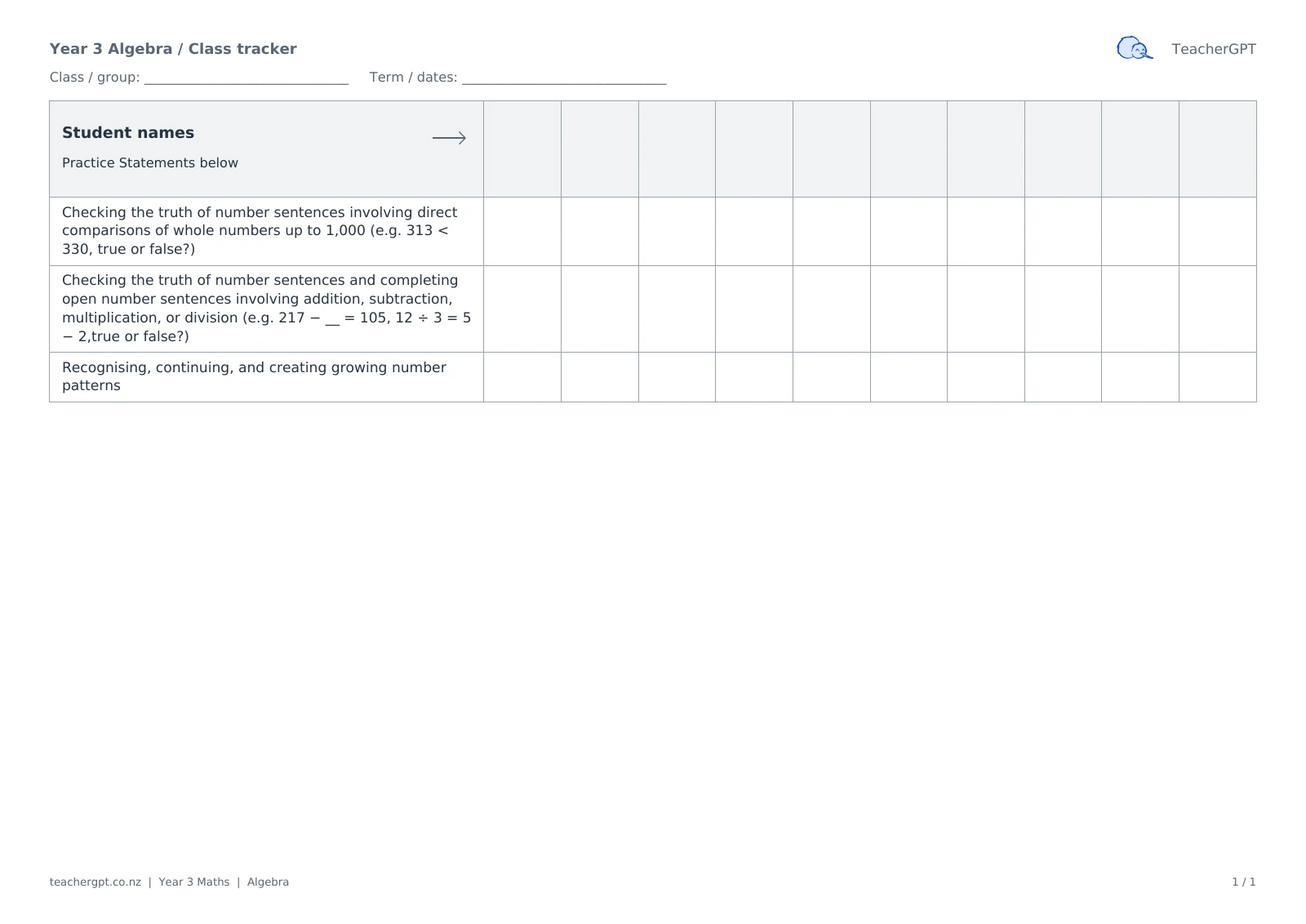
Checking the truth of number sentences involving direct comparisons of whole numbers up to 1,000 (e.g. 313 < 330, true or false?)
Checking the truth of number sentences and completing open number sentences involving addition, subtraction, multiplication, or division (e.g. 217 − __ = 105, 12 ÷ 3 = 5 − 2,true or false?)
Recognising, continuing, and creating growing number patterns
Geometry
Pathways
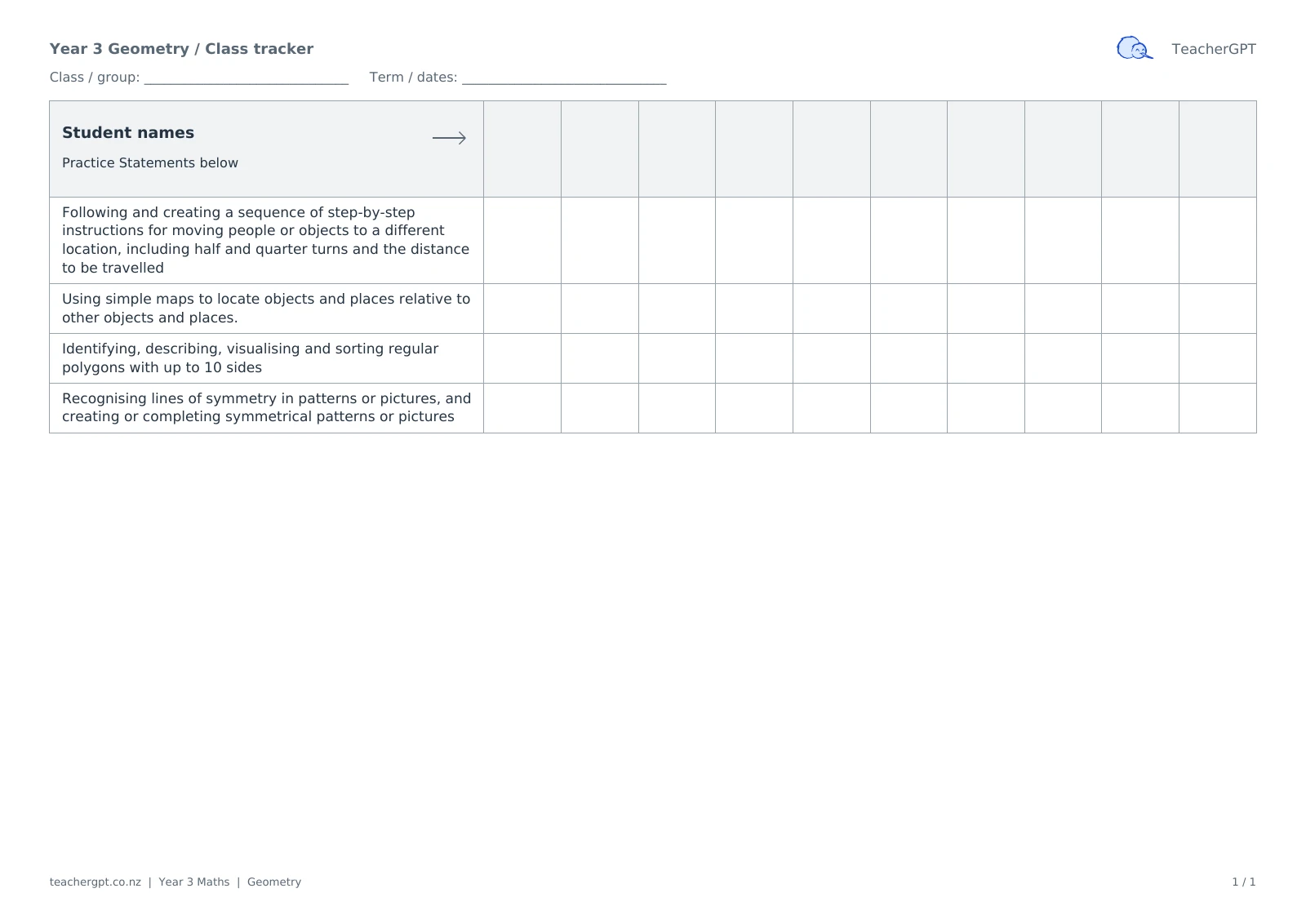
Following and creating a sequence of step-by-step instructions for moving people or objects to a different location, including half and quarter turns and the distance to be travelled
Using simple maps to locate objects and places relative to other objects and places.
Shapes
Identifying, describing, visualising and sorting regular polygons with up to 10 sides
Spatial reasoning
Recognising lines of symmetry in patterns or pictures, and creating or completing symmetrical patterns or pictures
The language of Mathematics and Statistics
Algebra
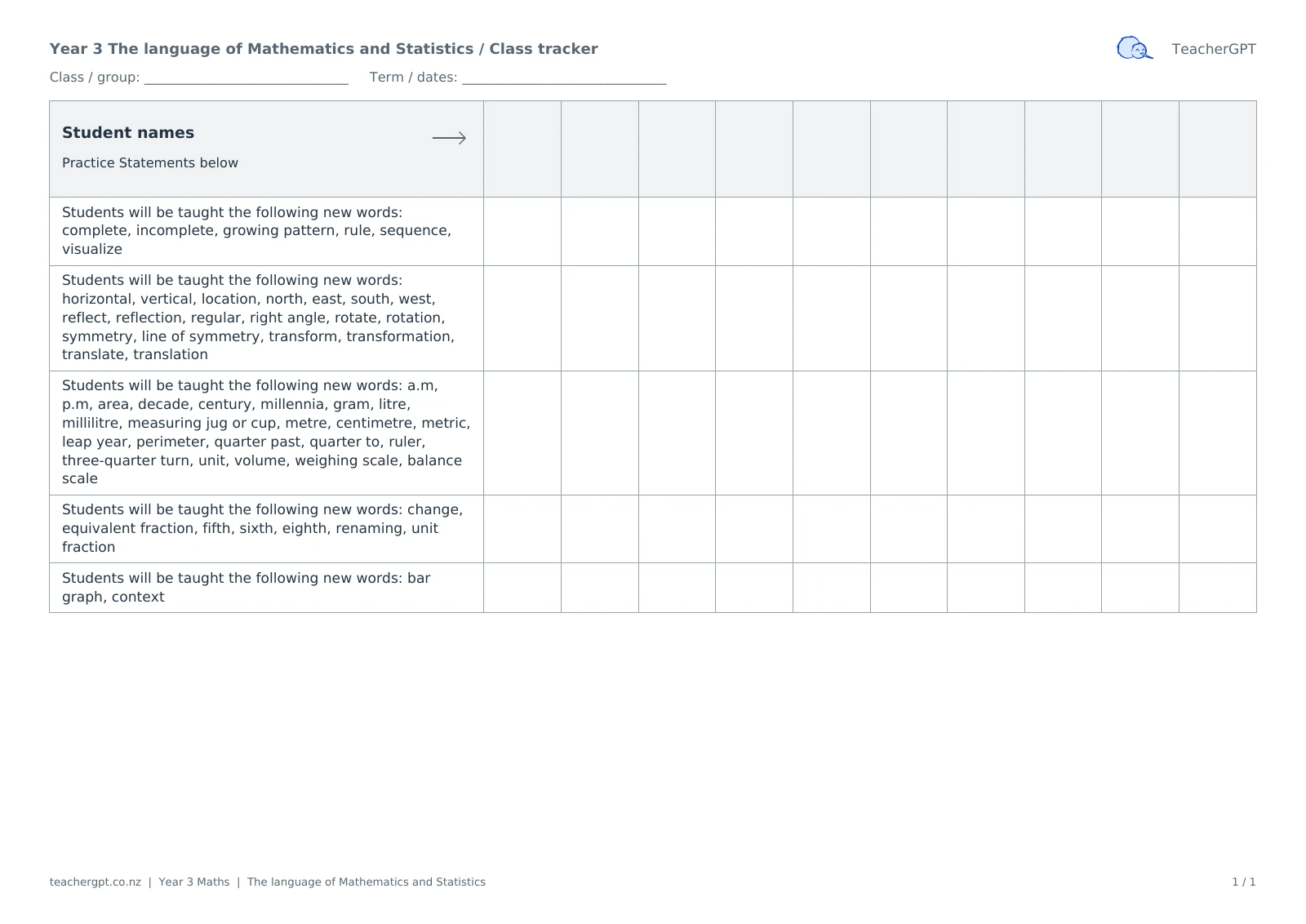
Students will be taught the following new words: complete, incomplete, growing pattern, rule, sequence, visualize
Geometry
Students will be taught the following new words: horizontal, vertical, location, north, east, south, west, reflect, reflection, regular, right angle, rotate, rotation, symmetry, line of symmetry, transform, transformation, translate, translation
Measurement
Students will be taught the following new words: a.m, p.m, area, decade, century, millennia, gram, litre, millilitre, measuring jug or cup, metre, centimetre, metric, leap year, perimeter, quarter past, quarter to, ruler, three-quarter turn, unit, volume, weighing scale, balance scale
Number
Students will be taught the following new words: change, equivalent fraction, fifth, sixth, eighth, renaming, unit fraction
Statistics
Students will be taught the following new words: bar graph, context
Measurement
Measuring
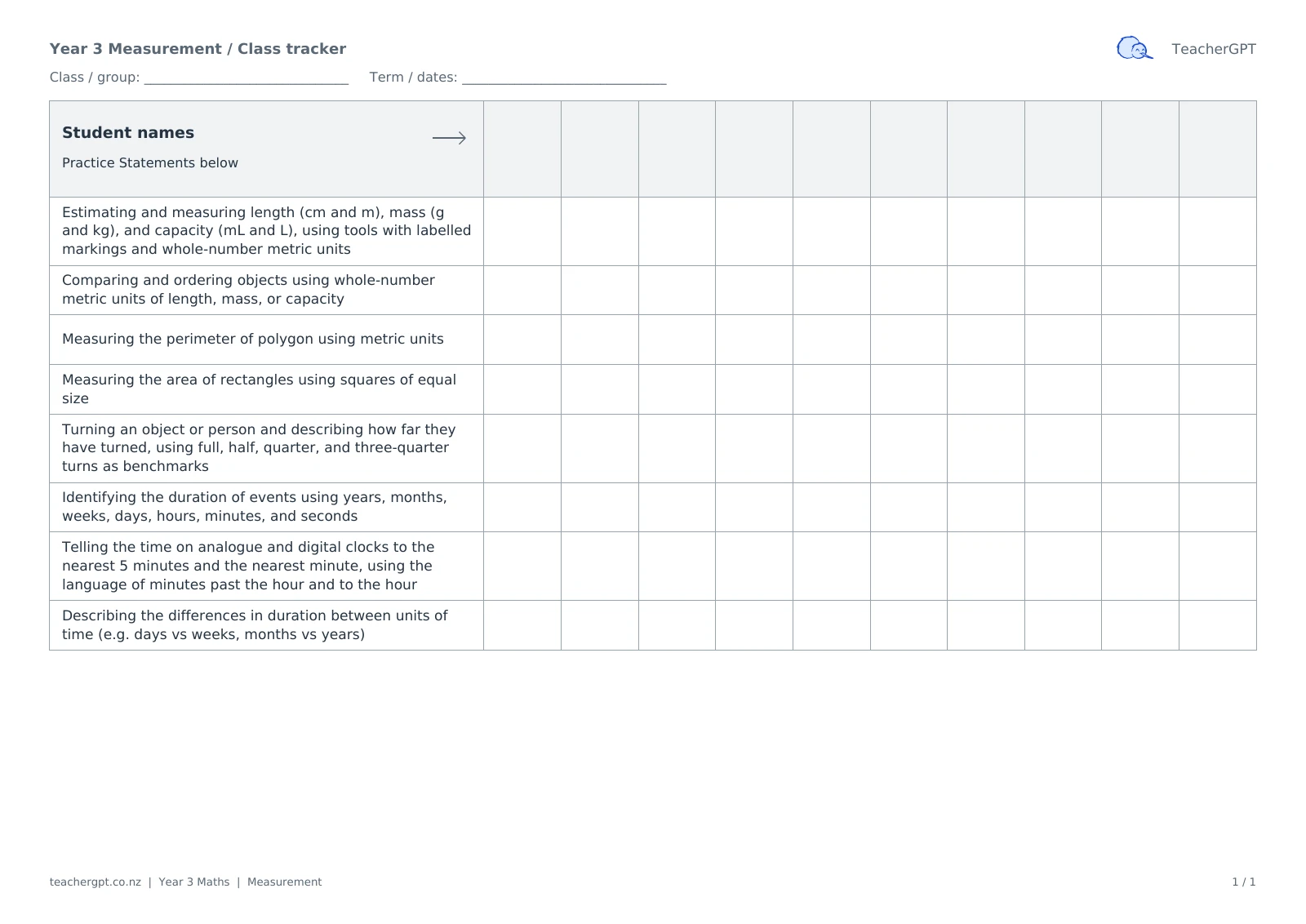
Estimating and measuring length (cm and m), mass (g and kg), and capacity (mL and L), using tools with labelled markings and whole-number metric units
Comparing and ordering objects using whole-number metric units of length, mass, or capacity
Measuring the perimeter of polygon using metric units
Measuring the area of rectangles using squares of equal size
Turning an object or person and describing how far they have turned, using full, half, quarter, and three-quarter turns as benchmarks
Identifying the duration of events using years, months, weeks, days, hours, minutes, and seconds
Telling the time on analogue and digital clocks to the nearest 5 minutes and the nearest minute, using the language of minutes past the hour and to the hour
Describing the differences in duration between units of time (e.g. days vs weeks, months vs years)
Number
Financial mathematics
Representing currency values of mixed dollars and cents without using decimal notation (e.g. $2 and 50 cents)
Making amounts of money using one- and two-dollar coins and 5-, 10-, 20-, 50-, and 100-dollar notes
Using addition and subtraction to give change
Number structures
Reading and writing whole numbers up to 1,000, and representing them using base 10 structure
Comparing and ordering whole numbers up to 1,000
Recognising the place value of each digit in a three-digit number
Finding the total number of objects beyond 120 by first separating them into groups (e.g. groups of 10 or 100)
Rounding numbers to the nearest 10 or 100
Estimating the answer to a calculation
Counting forwards and backwards in 2s, 3s, 4s, 5s, and 8s from multiples of these numbers (e.g. 20, 15, 10, 5; 8, 16, 24, 32)
Counting forwards and backwards in 10s and 100s from any whole number between 0 and 1000
Operations
Finding the complement of a number to 100 (e.g. 34 + __ = 100)
Adding and subtracting numbers up to 1000 (e.g. 329 + 3, 329 + 80, 329 − 200, 137 + 54)
Solving one-step addition and subtraction problems involving numbers up to 1000
Solving multi-step addition and subtraction problems involving numbers up to 100
Multiplying or dividing using equal sharing, grouping, repeated addition or subtraction, or known facts
Memorising multiplication and corresponding division facts for 2s, 3s, 4s, 5s, 8s, and 10s
Multiplying a one- or two-digit number by a one-digit number (e.g. 4 × 6; 2 × 23)
Dividing whole numbers by a one-digit divisor with no remainders (e.g. 24 ÷ 3, 32 ÷ 4)
Rational numbers
Reading, writing, and representing fractions of sets, quantities, and measurements on a number line, and of regions, using small denominators
Counting in unit fractions up to 1
Comparing unit fractions with denominators up to 12
Comparing non-unit fractions with the same denominator up to 12
Identifying when two fractions are equivalent, using representations
Adding and subtracting fractions with the same denominator within a whole (e.g. 1/8 + 2/8 + 3/8 = 6/8)
Finding a unit fraction of a whole number by connecting to division (e.g. 1/3 of 15 is found by 15 ÷ 3)
Finding the whole when given a unit fraction by connecting to repeated addition or multiplication (e.g. if 1/4 of a set is 3, the whole set is 4 × 3 = 12)
Statistics
Developing knowledge from data
Collecting categorical data and sorting the responses
Collecting numerical data by asking an investigative question with a response that is a count or a discrete measurement (i.e. a whole number) (e.g. How many teeth have been lost by the students in our class? What are the shoe sizes in the class?)
Interpretation of data
Describing data visualisations using the variable name and the context and giving the frequency for each category or number
Answering questions about data visualisations, including which category has the most or least items and questions involving operations (e.g. How many teeth did our class lose in total?)
Visualisation of data
Creating data visualisations for categorical and numerical data