A simple tracker for your class. Practice Statements down the left, ten student-name spaces across the top, and blank cells to use your way.
Choose a strand below. Write in the names, then add your own ticks, dates, codes or notes. For a class of 25, print three copies of the tracker.
70 Practice Statements · 7 strands · PDF and Google Sheets · No TeacherGPT signup needed
Choose a tracker by strand
Each preview shows the first page of that PDF. Longer strands continue over several pages, with space for the same ten names on every page.
Prefer to work online? Choose Copy to Google Sheets to make your own editable copy in your Google account. The original is view-only. Add student names and notes to your own copy, and add more student columns if needed.
In the Number PDF, each curriculum subcategory starts on a new page. Longer subcategories continue under the same heading.
Algebra
5 Practice Statements · 1 page · 10 student columns
These trackers cover all 70 stored Year 6 Maths Practice Statements, organised into their curriculum strands and skill groups.
Algebra
Equations and relationships
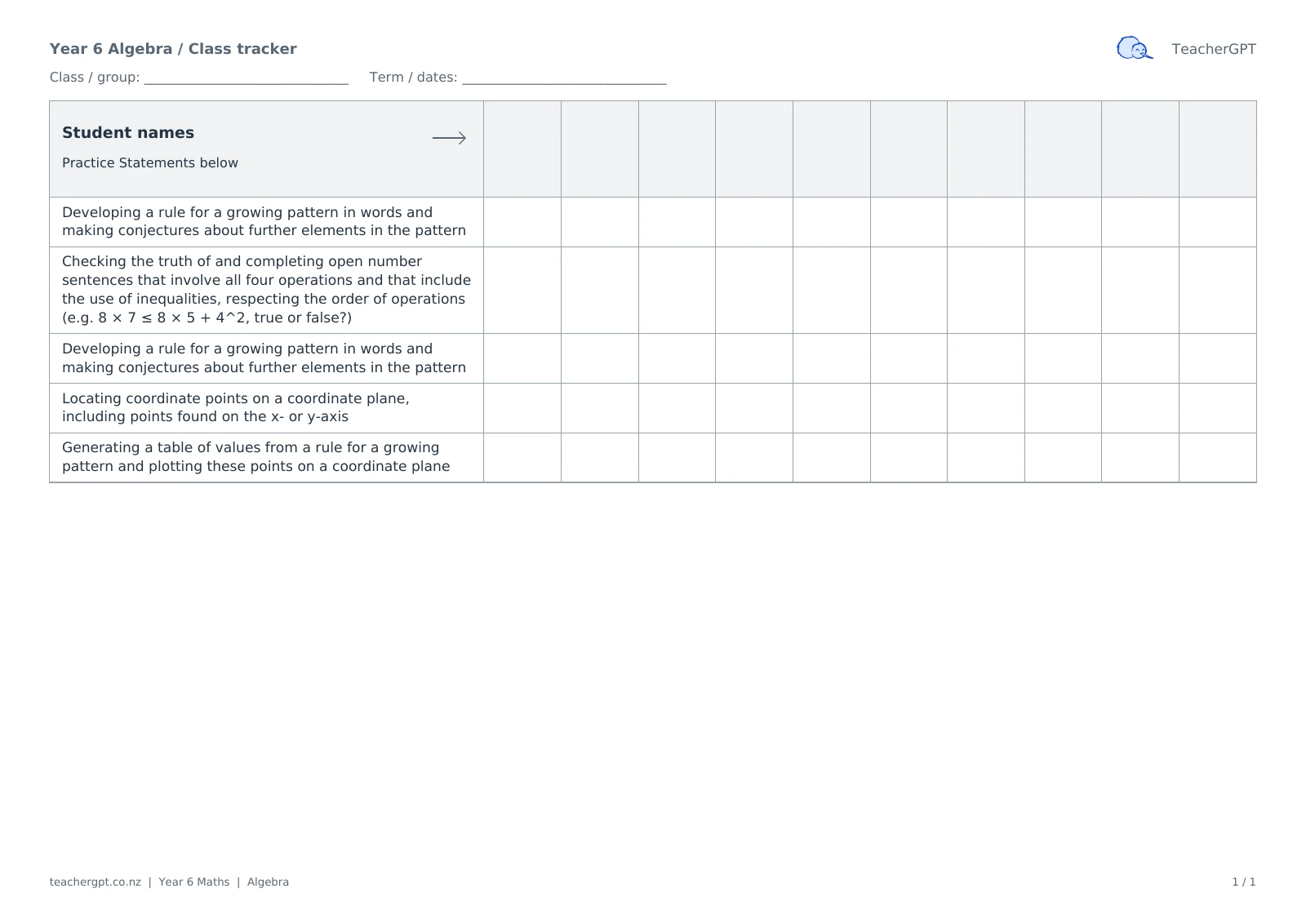
Developing a rule for a growing pattern in words and making conjectures about further elements in the pattern
Checking the truth of and completing open number sentences that involve all four operations and that include the use of inequalities, respecting the order of operations (e.g. 8 × 7 ≤ 8 × 5 + 4^2, true or false?)
Developing a rule for a growing pattern in words and making conjectures about further elements in the pattern
Locating coordinate points on a coordinate plane, including points found on the x- or y-axis
Generating a table of values from a rule for a growing pattern and plotting these points on a coordinate plane
Geometry
Pathways
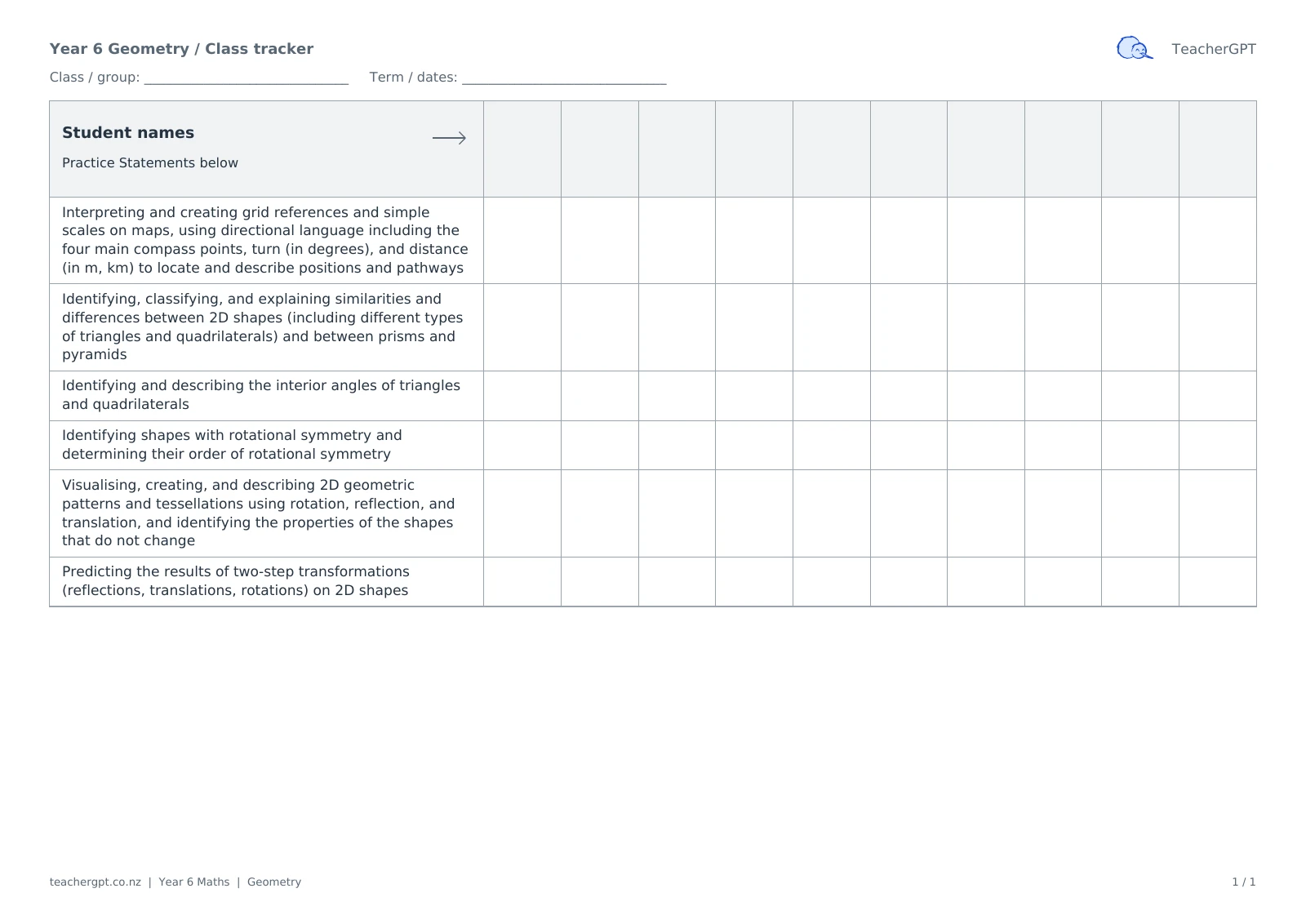
Interpreting and creating grid references and simple scales on maps, using directional language including the four main compass points, turn (in degrees), and distance (in m, km) to locate and describe positions and pathways
Shapes
Identifying, classifying, and explaining similarities and differences between 2D shapes (including different types of triangles and quadrilaterals) and between prisms and pyramids
Identifying and describing the interior angles of triangles and quadrilaterals
Identifying shapes with rotational symmetry and determining their order of rotational symmetry
Spatial reasoning
Visualising, creating, and describing 2D geometric patterns and tessellations using rotation, reflection, and translation, and identifying the properties of the shapes that do not change
Predicting the results of two-step transformations (reflections, translations, rotations) on 2D shapes
The language of Mathematics and Statistics
Algebra
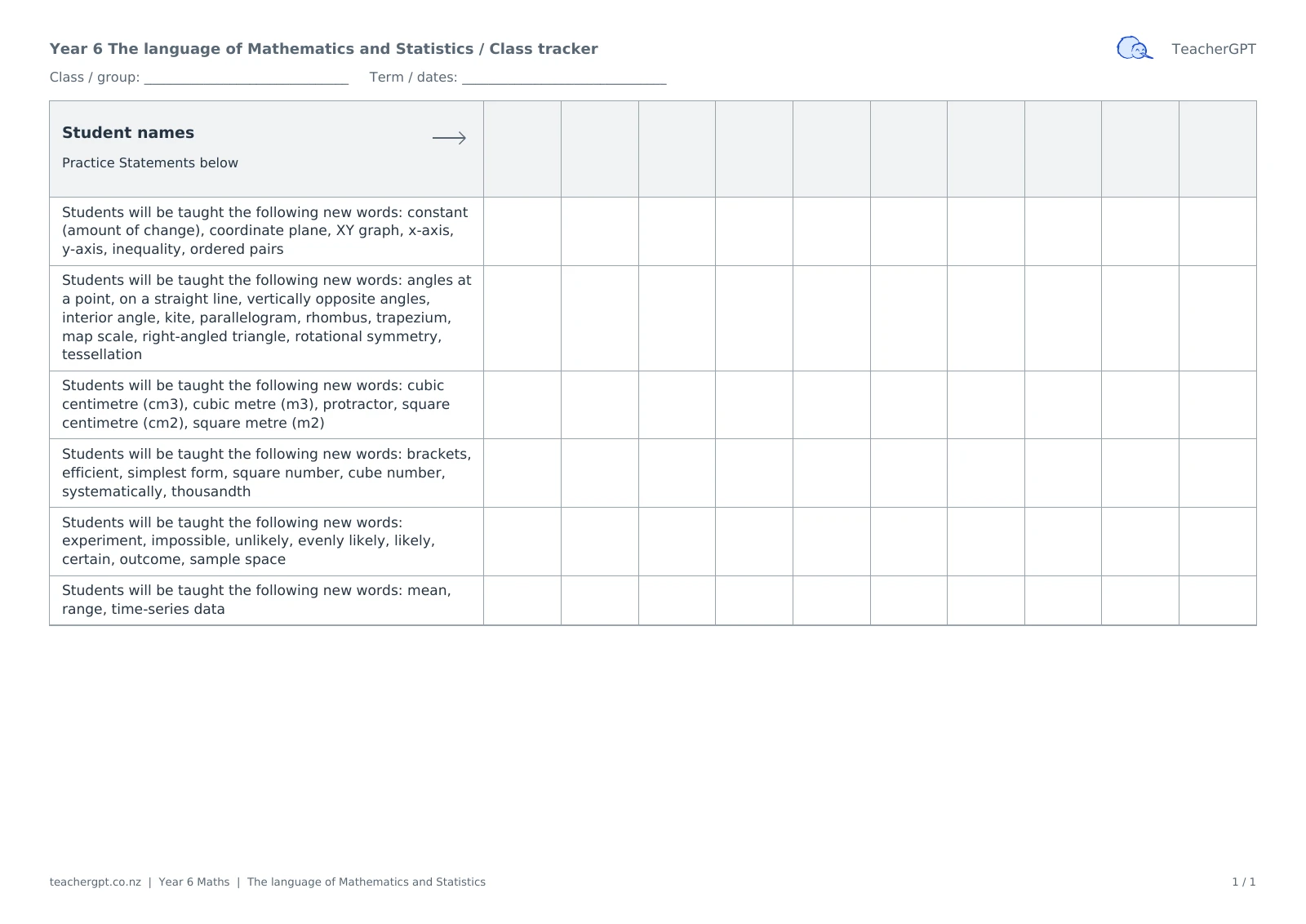
Students will be taught the following new words: constant (amount of change), coordinate plane, XY graph, x-axis, y-axis, inequality, ordered pairs
Geometry
Students will be taught the following new words: angles at a point, on a straight line, vertically opposite angles, interior angle, kite, parallelogram, rhombus, trapezium, map scale, right-angled triangle, rotational symmetry, tessellation
Measurement
Students will be taught the following new words: cubic centimetre (cm3), cubic metre (m3), protractor, square centimetre (cm2), square metre (m2)
Number
Students will be taught the following new words: brackets, efficient, simplest form, square number, cube number, systematically, thousandth
Probability
Students will be taught the following new words: experiment, impossible, unlikely, evenly likely, likely, certain, outcome, sample space
Statistics
Students will be taught the following new words: mean, range, time-series data
Measurement
Measuring
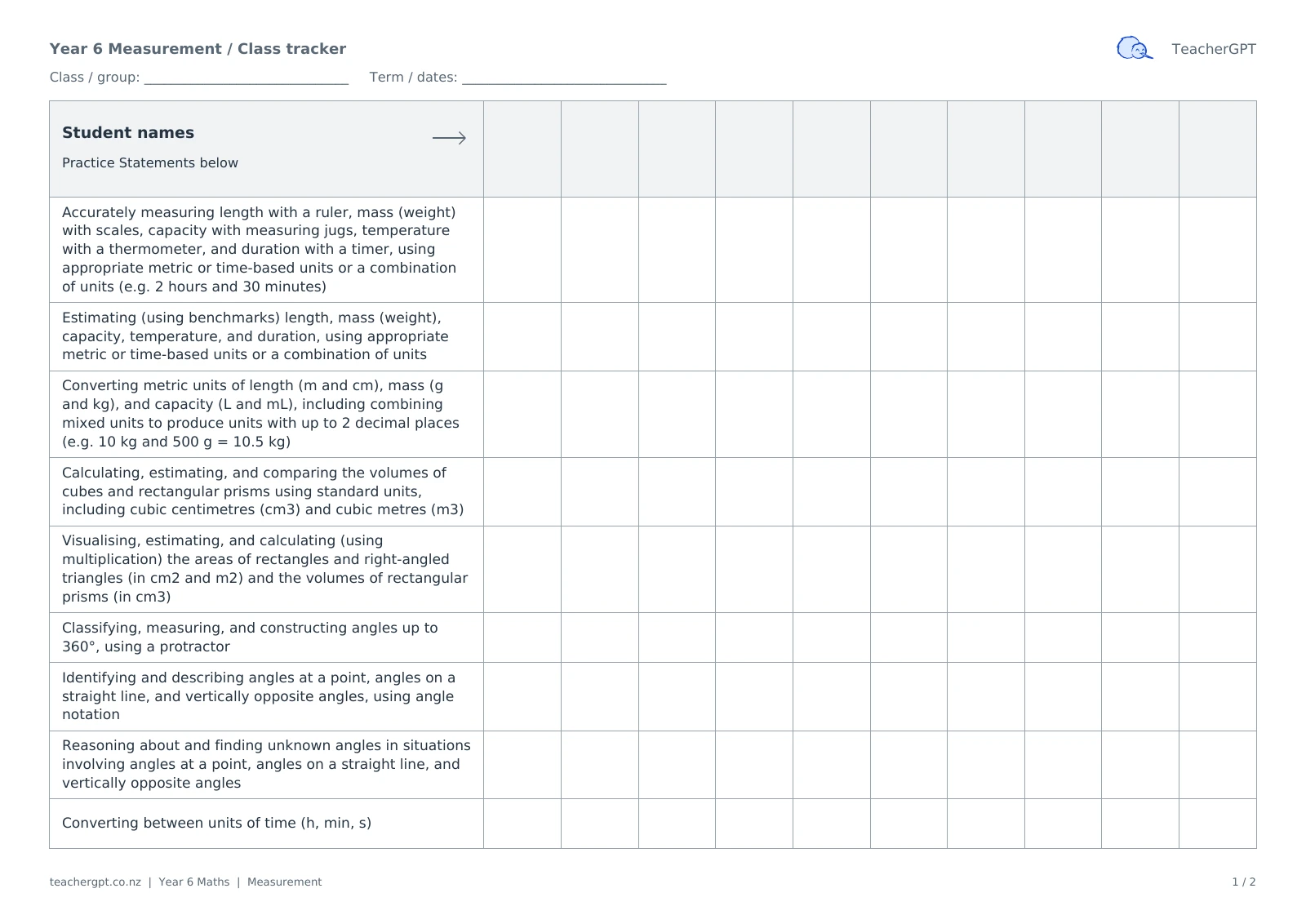
Accurately measuring length with a ruler, mass (weight) with scales, capacity with measuring jugs, temperature with a thermometer, and duration with a timer, using appropriate metric or time-based units or a combination of units (e.g. 2 hours and 30 minutes)
Estimating (using benchmarks) length, mass (weight), capacity, temperature, and duration, using appropriate metric or time-based units or a combination of units
Converting metric units of length (m and cm), mass (g and kg), and capacity (L and mL), including combining mixed units to produce units with up to 2 decimal places (e.g. 10 kg and 500 g = 10.5 kg)
Calculating, estimating, and comparing the volumes of cubes and rectangular prisms using standard units, including cubic centimetres (cm3) and cubic metres (m3)
Visualising, estimating, and calculating (using multiplication) the areas of rectangles and right-angled triangles (in cm2 and m2) and the volumes of rectangular prisms (in cm3)
Classifying, measuring, and constructing angles up to 360°, using a protractor
Identifying and describing angles at a point, angles on a straight line, and vertically opposite angles, using angle notation
Reasoning about and finding unknown angles in situations involving angles at a point, angles on a straight line, and vertically opposite angles
Converting between units of time (h, min, s)
Measuring duration in both 12- and 24-hour time systems
Finding elapsed time in minutes across an hour (e.g. the difference between 2:53 pm and 3:28 pm)
Using and interpreting timetables to calculate the duration of events (e.g. bus and train schedules)
Number
Financial mathematics
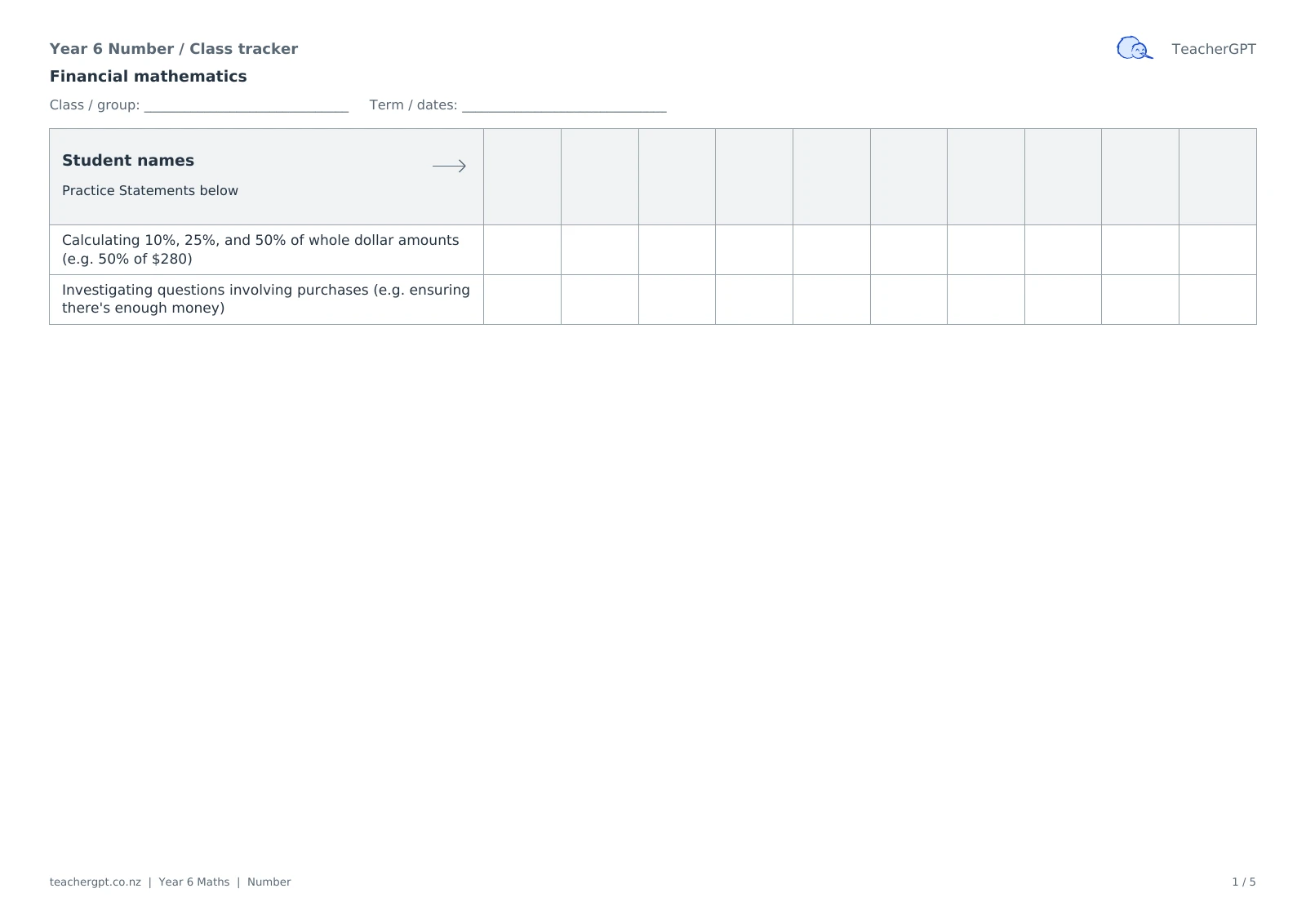
Calculating 10%, 25%, and 50% of whole dollar amounts (e.g. 50% of $280)
Reading, writing, comparing, and ordering any whole number and representing them using base 10 structure
Finding factor pairs for numbers that result from multiplying any two whole numbers between 1 and 12
Rounding whole numbers to the nearest million, hundred thousand, ten thousand, thousand, hundred, or ten
Rounding hundredths to the nearest whole number or tenth
Recognising square and cube numbers and the notation for squared (2) and cubed (3)
Memorising the square numbers to 144 and cube numbers to 125
Counting forwards and backwards with positive whole numbers, including working with negative numbers (e.g. starting at −6 and counting backwards in 2s)
Operations
Adding and subtracting any whole numbers
Multiplying any whole number by a two-digit number (e.g. 542 × 12)
Dividing up to five-digit whole numbers by a one-digit divisor, with a remainder (e.g. 1283 ÷ 5 = 256, remainder 3)
Connecting finding unit fractions of whole numbers to division (with remainders) (e.g. 1—6 of 31 is equivalent to 31 ÷ 6 = 51—6 )
Representing remainders from division as whole numbers, fractions, or rounded decimals, as appropriate to the context
Rational numbers
Reading, writing, and representing tenths, hundredths, and thousandths as fractions and decimals
Comparing and ordering numbers with up to three decimal places
Memorising decimal and percentage equivalents of common fractions (1/2, 1/4, 3/4, 1/5, 2/5, 3/5, 4/5) including fractions with denominators that are 10 or 100
Converting decimal tenths and hundredths to fractions and percentages (e.g. 0.31 = 31/100 = 31%)
Multiplying and dividing numbers by 10, 100, or 1,000 to make decimals and whole numbers (e.g. 1.3 × 10 = 13) and to identify tenths, hundredths, and thousandths places
Finding equivalent fractions
Comparing and ordering fractions where at least one denominator is a common multiple of all the others
Converting between mixed numbers and improper fractions
Adding and subtracting fractions and mixed numbers when one denominator is a multiple of the other
Adding and subtracting decimals to three decimal places
Finding a non-unit fraction of a whole number, using multiplication and division facts and where the answer is a whole number (e.g. 2/3 of 240)
Finding a whole set or amount when given a non-unit fraction, using multiplication and division facts (e.g. 3/4 of the set is 90, what is the whole set?)
Finding common percentages (1%, 10%, 20%, 25%, 50%, 75%) of whole numbers
Finding the whole (100%) when given a percentage (e.g. 75% is 24)
Reasoning proportionally with fractions, decimals, and percentages to compare two quantities and determine missing values
Probability
Experimental probability
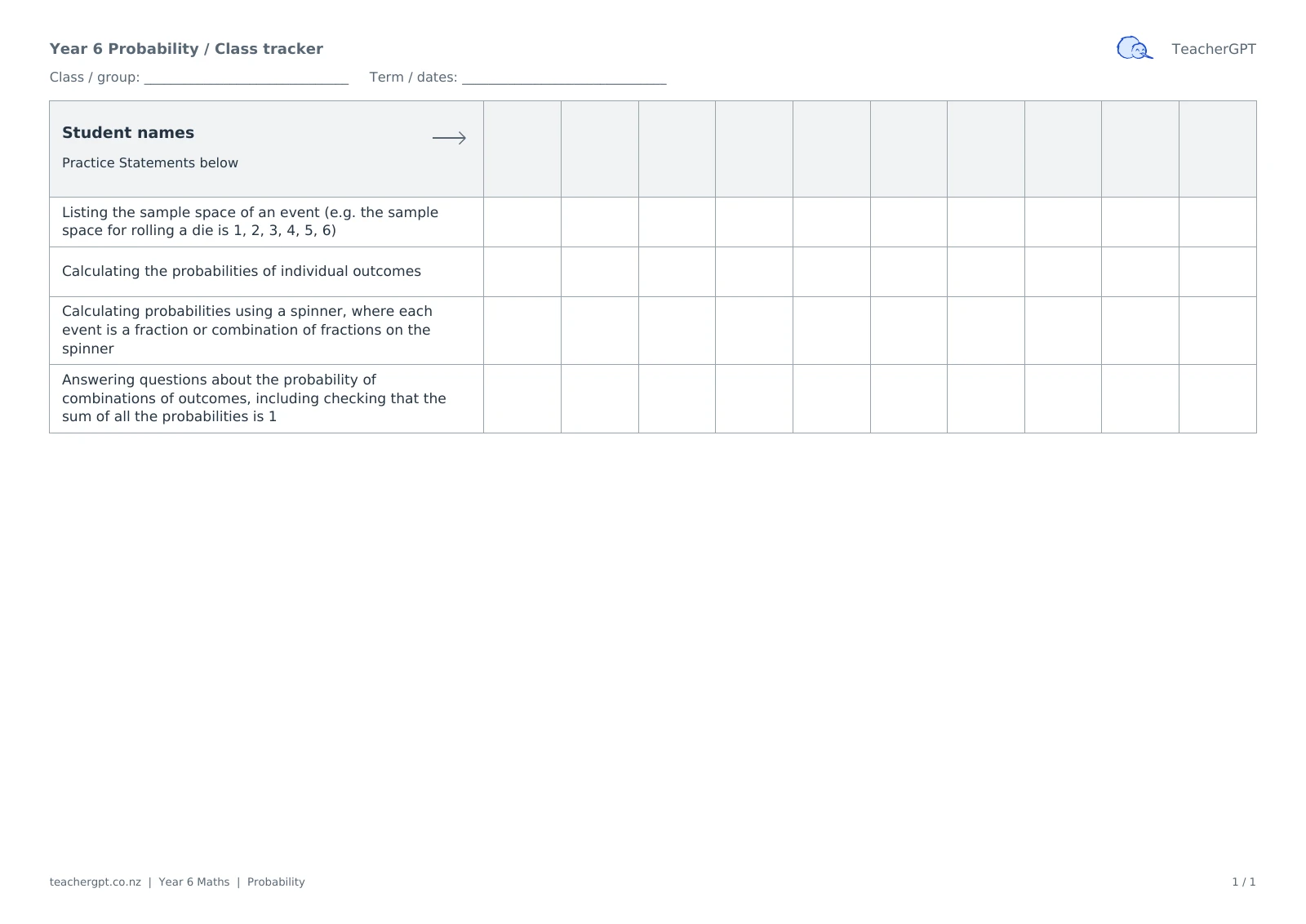
Listing the sample space of an event (e.g. the sample space for rolling a die is 1, 2, 3, 4, 5, 6)
Calculating the probabilities of individual outcomes
Calculating probabilities using a spinner, where each event is a fraction or combination of fractions on the spinner
Answering questions about the probability of combinations of outcomes, including checking that the sum of all the probabilities is 1
Statistics
Developing knowledge from data
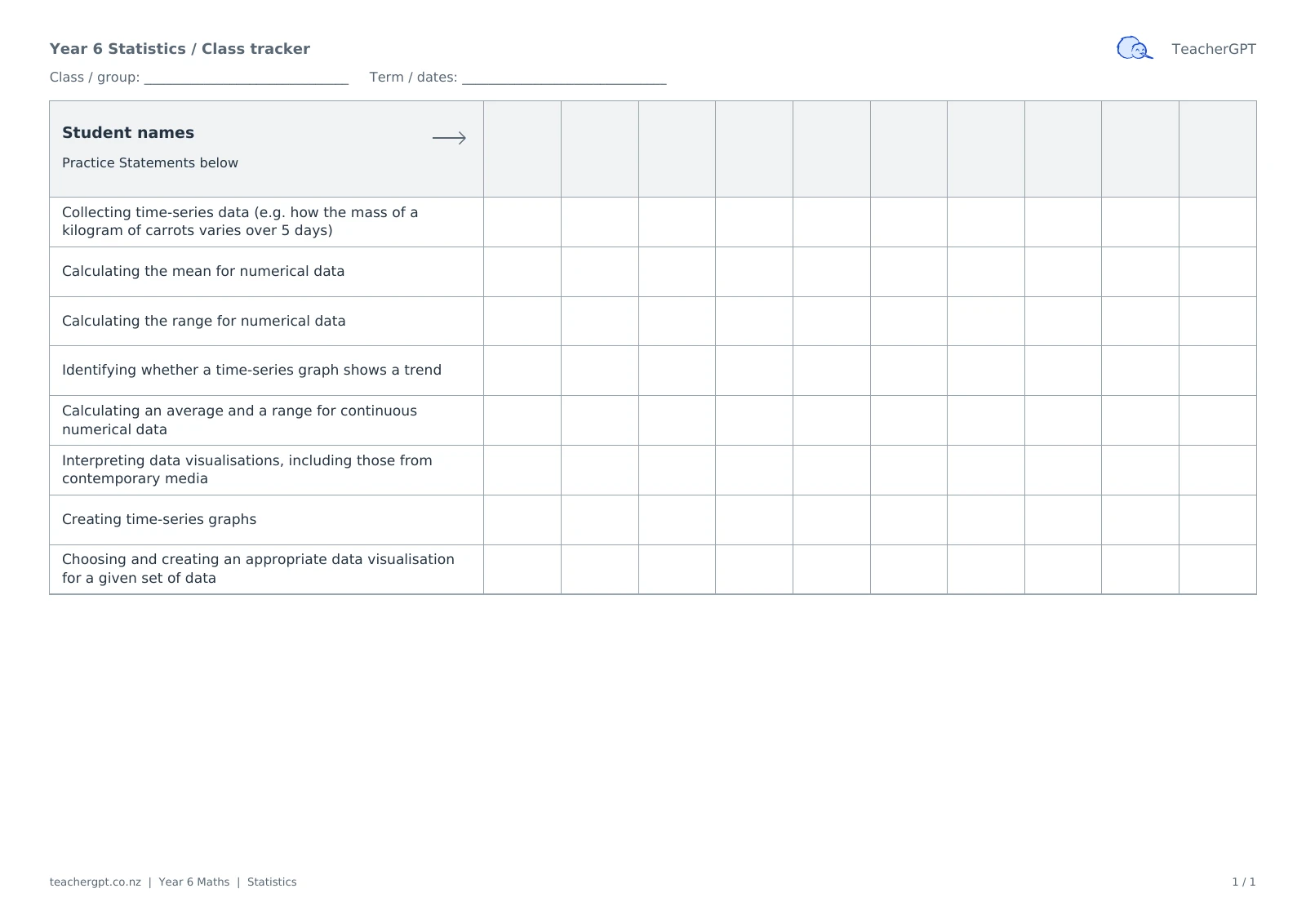
Collecting time-series data (e.g. how the mass of a kilogram of carrots varies over 5 days)
Calculating the mean for numerical data
Calculating the range for numerical data
Interpretation of data
Identifying whether a time-series graph shows a trend
Calculating an average and a range for continuous numerical data
Interpreting data visualisations, including those from contemporary media
Visualisation of data
Creating time-series graphs
Choosing and creating an appropriate data visualisation for a given set of data