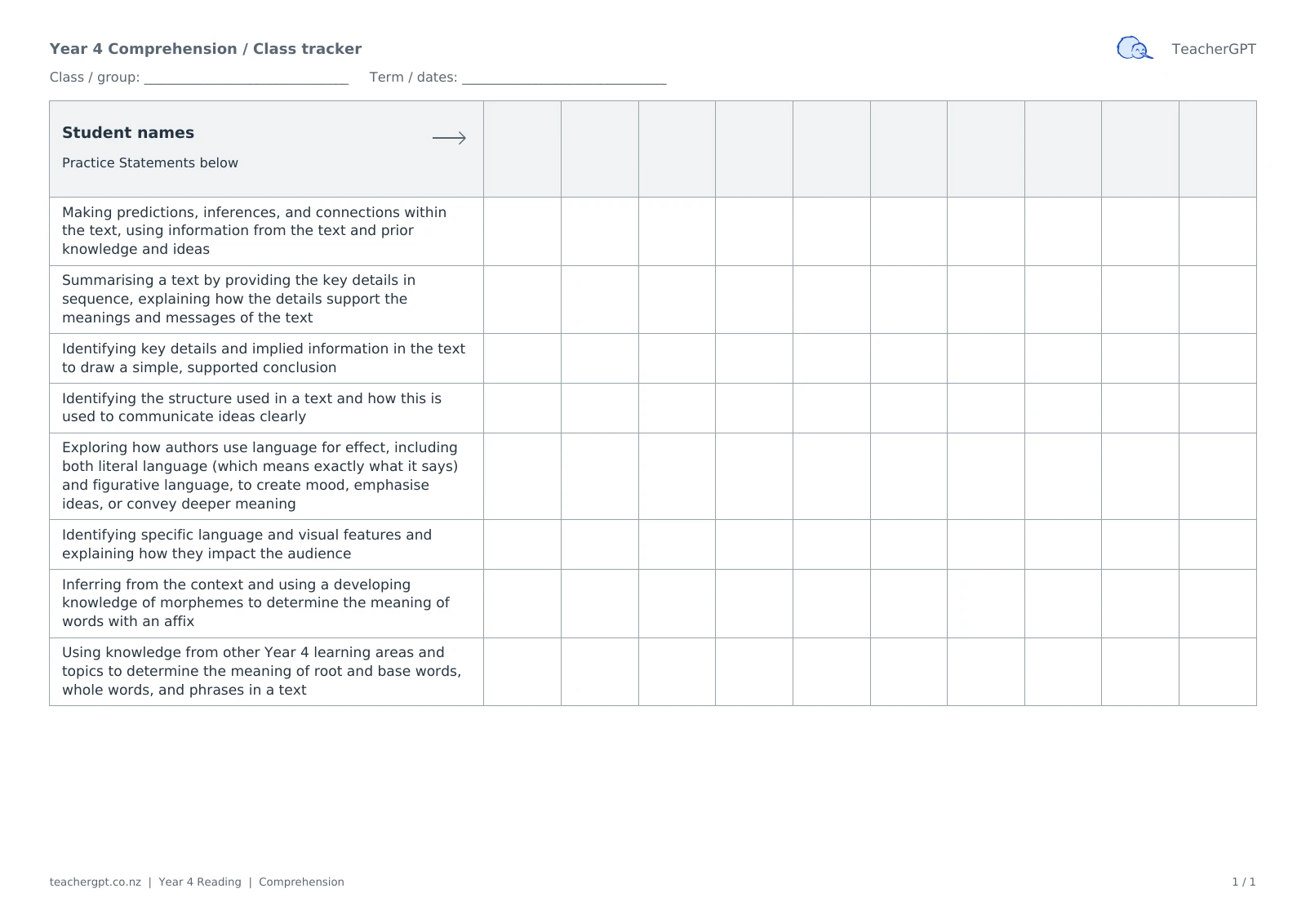
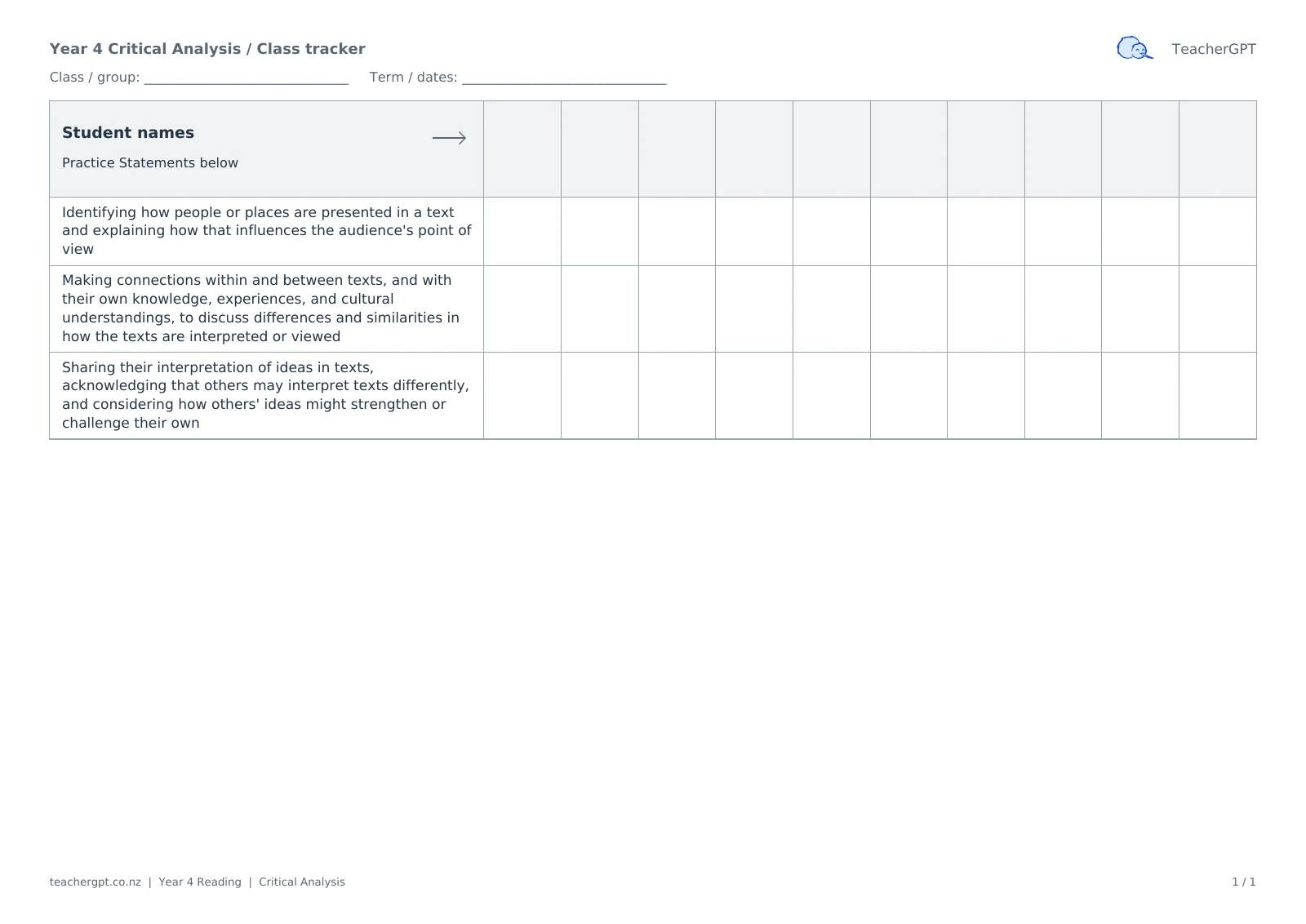
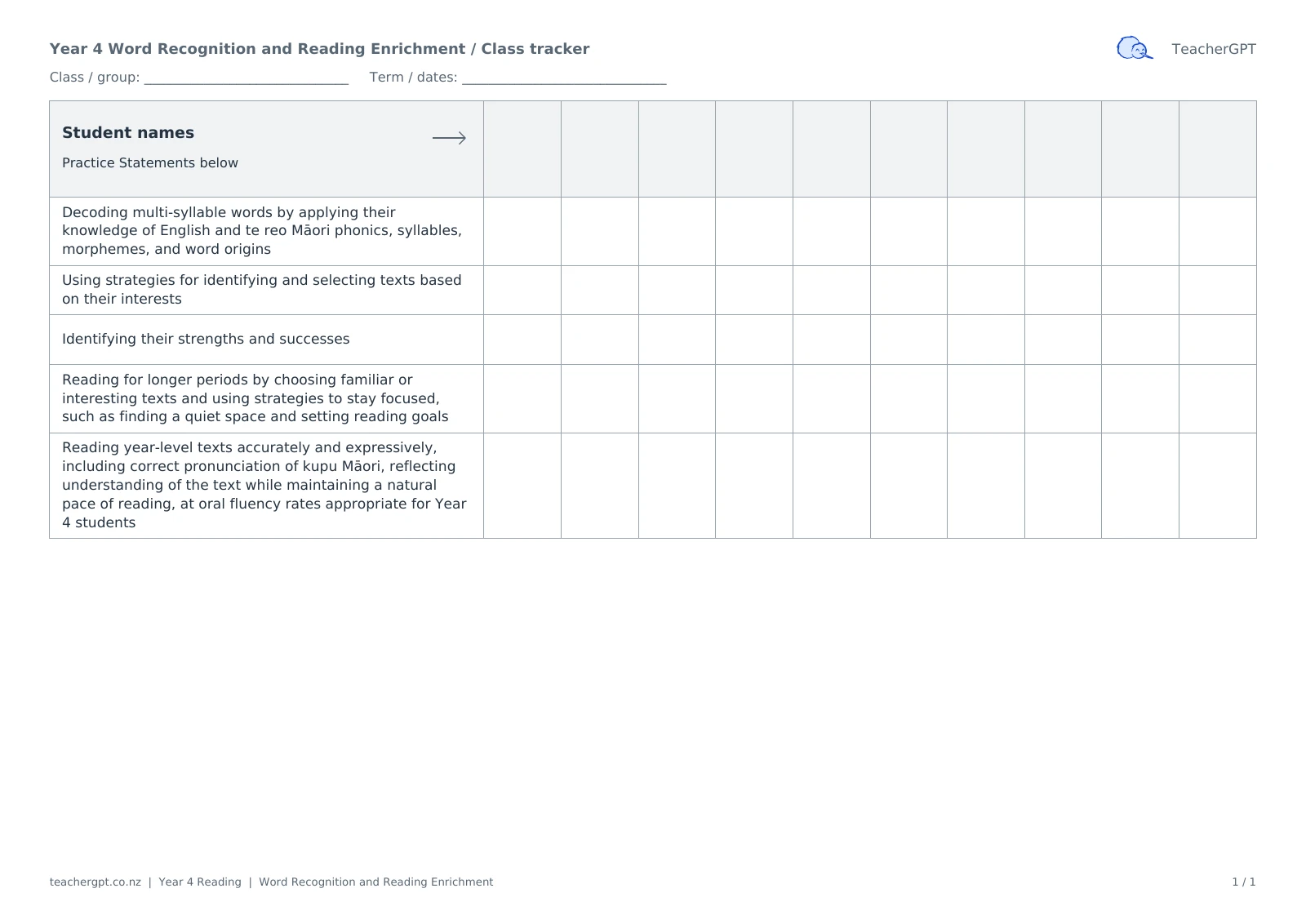
A simple tracker for your class. Practice Statements down the left, ten student-name spaces across the top, and blank cells to use your way.
Choose a strand below. Write in the names, then add your own ticks, dates, codes or notes. For a class of 25, print three copies of the tracker.
16 Practice Statements · 3 strands · PDF and Google Sheets · No TeacherGPT signup needed
Choose a tracker by strand
Each preview shows the first page of that PDF. Longer strands continue over several pages, with space for the same ten names on every page.
Prefer to work online? Choose Copy to Google Sheets to make your own editable copy in your Google account. The original is view-only. Add student names and notes to your own copy, and add more student columns if needed.
Comprehension
8 Practice Statements · 1 page · 10 student columns
These trackers cover all 16 stored Year 4 Reading Practice Statements, organised into their curriculum strands and skill groups.
Comprehension
Comprehension strategies
Making predictions, inferences, and connections within the text, using information from the text and prior knowledge and ideas
Summarising a text by providing the key details in sequence, explaining how the details support the meanings and messages of the text
Identifying key details and implied information in the text to draw a simple, supported conclusion
Text form, structure, style, and features
Identifying the structure used in a text and how this is used to communicate ideas clearly
Exploring how authors use language for effect, including both literal language (which means exactly what it says) and figurative language, to create mood, emphasise ideas, or convey deeper meaning
Identifying specific language and visual features and explaining how they impact the audience
Vocabulary
Inferring from the context and using a developing knowledge of morphemes to determine the meaning of words with an affix
Using knowledge from other Year 4 learning areas and topics to determine the meaning of root and base words, whole words, and phrases in a text
Critical Analysis
Context and purpose
Identifying how people or places are presented in a text and explaining how that influences the audience's point of view
Interpretations and connections
Making connections within and between texts, and with their own knowledge, experiences, and cultural understandings, to discuss differences and similarities in how the texts are interpreted or viewed
Sharing their interpretation of ideas in texts, acknowledging that others may interpret texts differently, and considering how others' ideas might strengthen or challenge their own
Word Recognition and Reading Enrichment
Decoding
Decoding multi-syllable words by applying their knowledge of English and te reo Māori phonics, syllables, morphemes, and word origins
Developing confident readers
Using strategies for identifying and selecting texts based on their interests
Identifying their strengths and successes
Reading for longer periods by choosing familiar or interesting texts and using strategies to stay focused, such as finding a quiet space and setting reading goals
Fluency
Reading year-level texts accurately and expressively, including correct pronunciation of kupu Māori, reflecting understanding of the text while maintaining a natural pace of reading, at oral fluency rates appropriate for Year 4 students