Free resources / Assessment and Tracking / Year 1 Reading Free NZ teacher resources
Year 1 Reading Practice Statement trackers
A simple tracker for your class. Practice Statements down the left, ten student-name spaces across the top, and blank cells to use your way.
Choose a strand below. Write in the names, then add your own ticks, dates, codes or notes. For a class of 25, print three copies of the tracker.
24 Practice Statements · 3 strands · PDF and Google Sheets · No TeacherGPT signup needed
Choose a tracker by strand
Each preview shows the first page of that PDF. Longer strands continue over several pages, with space for the same ten names on every page.
Prefer to work online? Choose Copy to Google Sheets to make your own editable copy in your Google account. The original is view-only. Add student names and notes to your own copy, and add more student columns if needed.
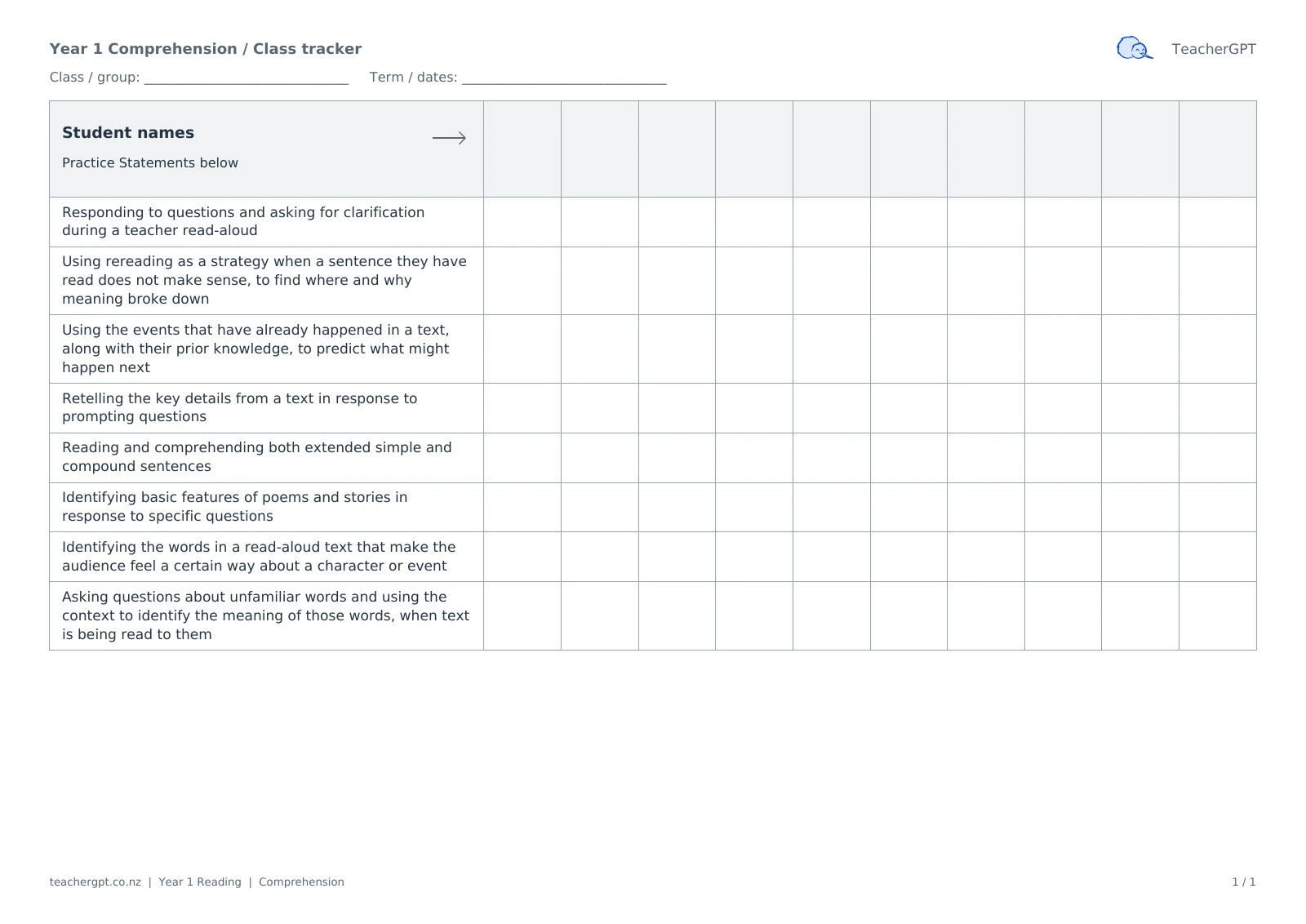
Comprehension
8 Practice Statements · 1 page · 10 student columns
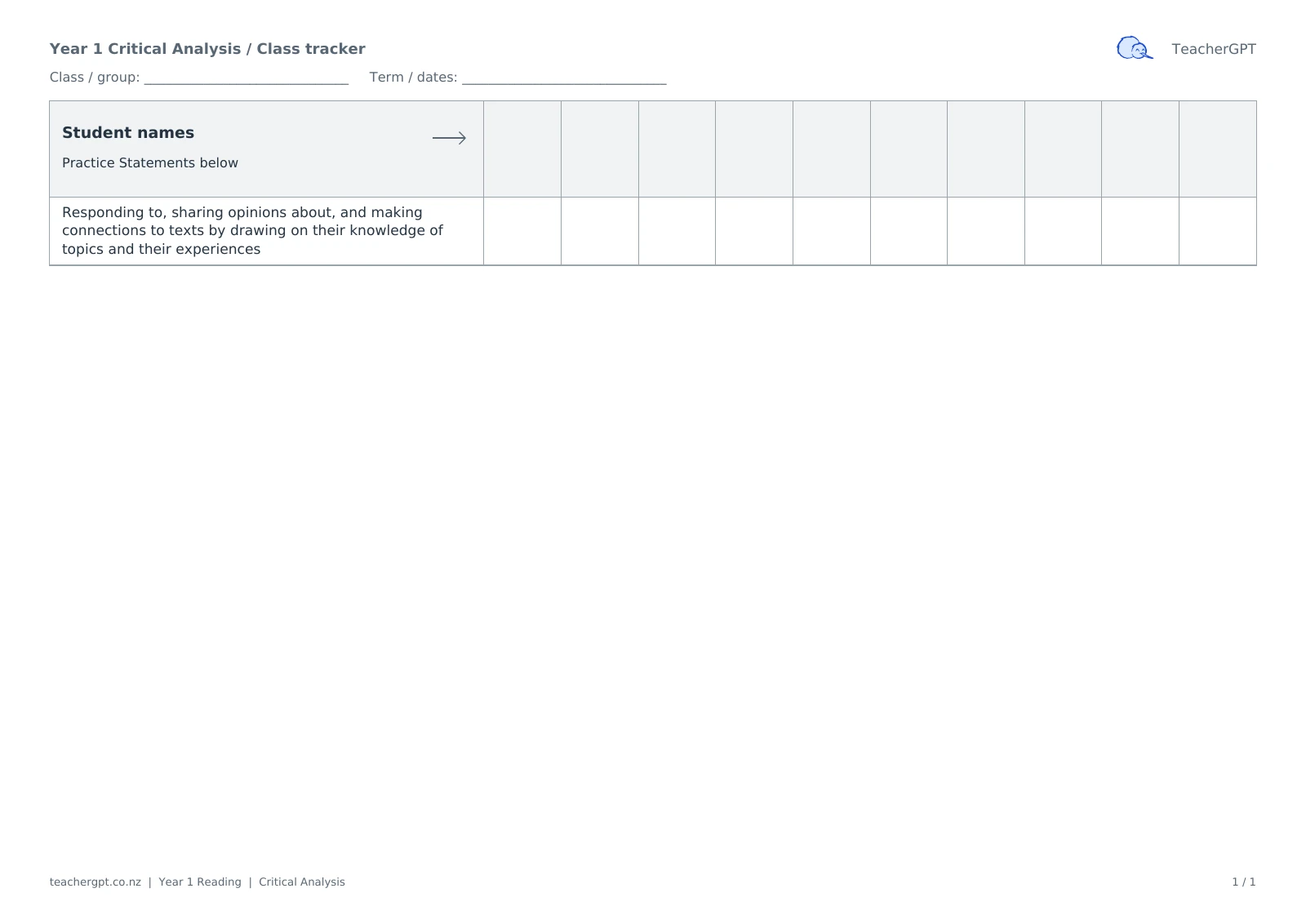
Critical Analysis
1 Practice Statement · 1 page · 10 student columns
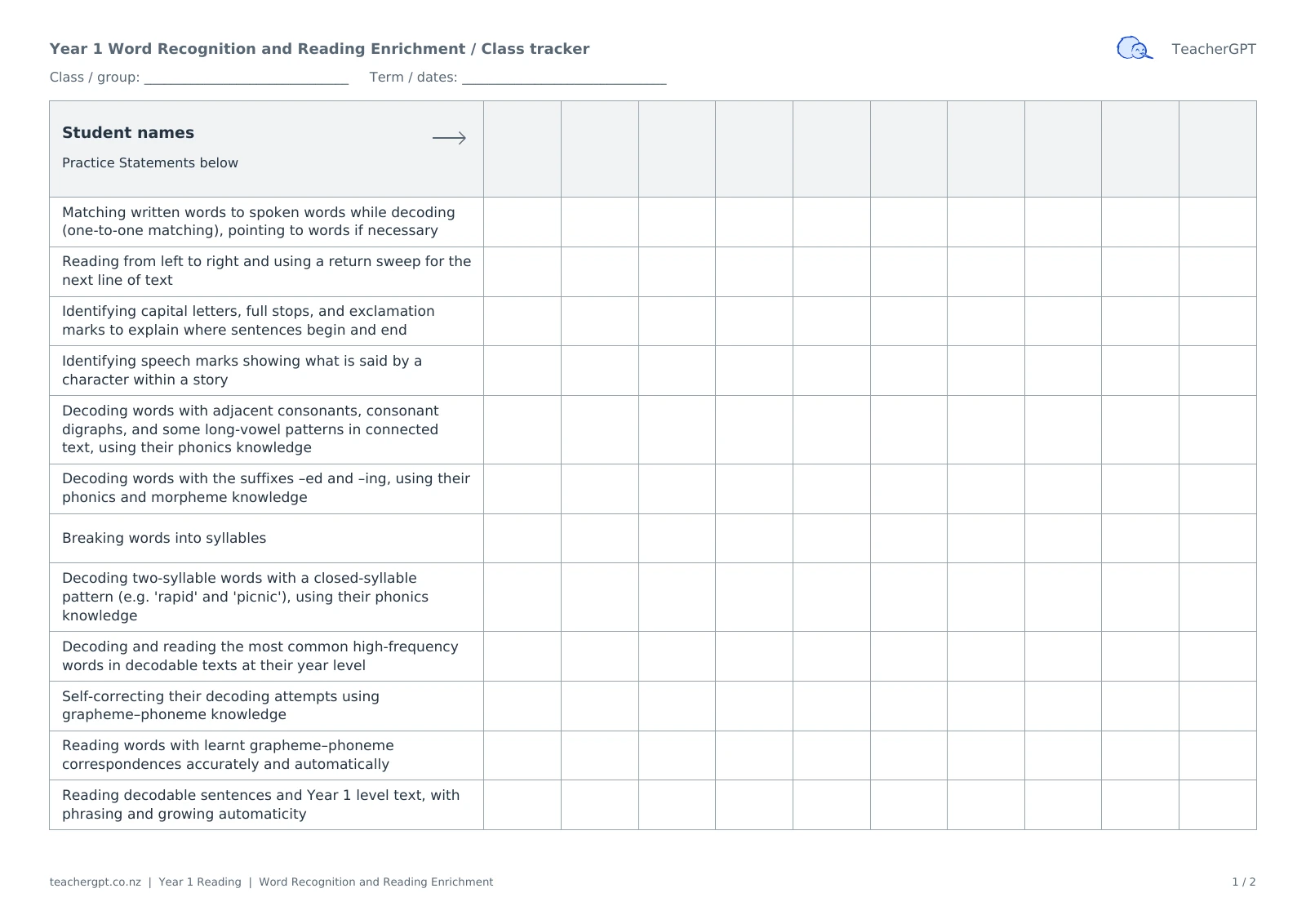
Word Recognition and Reading Enrichment
15 Practice Statements · 2 pages · 10 student columns
Practice Statements included
These trackers cover all 24 stored Year 1 Reading Practice Statements, organised into their curriculum strands and skill groups.
Comprehension
Comprehension strategies
Responding to questions and asking for clarification during a teacher read-aloud
Using rereading as a strategy when a sentence they have read does not make sense, to find where and why meaning broke down
Using the events that have already happened in a text, along with their prior knowledge, to predict what might happen next
Retelling the key details from a text in response to prompting questions
Sentence structure
Reading and comprehending both extended simple and compound sentences
Text form, structure, style, and features
Identifying basic features of poems and stories in response to specific questions
Identifying the words in a read-aloud text that make the audience feel a certain way about a character or event
Vocabulary
Asking questions about unfamiliar words and using the context to identify the meaning of those words, when text is being read to them
Critical Analysis
Interpretations and connections
Responding to, sharing opinions about, and making connections to texts by drawing on their knowledge of topics and their experiences
Word Recognition and Reading Enrichment
Conventions of print
Matching written words to spoken words while decoding (one-to-one matching), pointing to words if necessary
Reading from left to right and using a return sweep for the next line of text
Identifying capital letters, full stops, and exclamation marks to explain where sentences begin and end
Identifying speech marks showing what is said by a character within a story
Decoding
Decoding words with adjacent consonants, consonant digraphs, and some long-vowel patterns in connected text, using their phonics knowledge
Decoding words with the suffixes –ed and –ing, using their phonics and morpheme knowledge
Breaking words into syllables
Decoding two-syllable words with a closed-syllable pattern (e.g. 'rapid' and 'picnic'), using their phonics knowledge
Decoding and reading the most common high-frequency words in decodable texts at their year level
Self-correcting their decoding attempts using grapheme–phoneme knowledge
Fluency
Reading words with learnt grapheme–phoneme correspondences accurately and automatically
Reading decodable sentences and Year 1 level text, with phrasing and growing automaticity
Phonemic awareness and phonics knowledge
Discriminating between short- and long-vowel phonemes
Orally blending up to six phonemes to make words
Pronouncing the most frequent phoneme(s) for all consonant digraphs and some long-vowel graphemes
Plan your next steps with TeacherGPT
Use your classroom observations to help plan teaching or draft report comments.
PDF downloads need no account. To save a Google Sheets copy, sign in to Google. No TeacherGPT account is required.