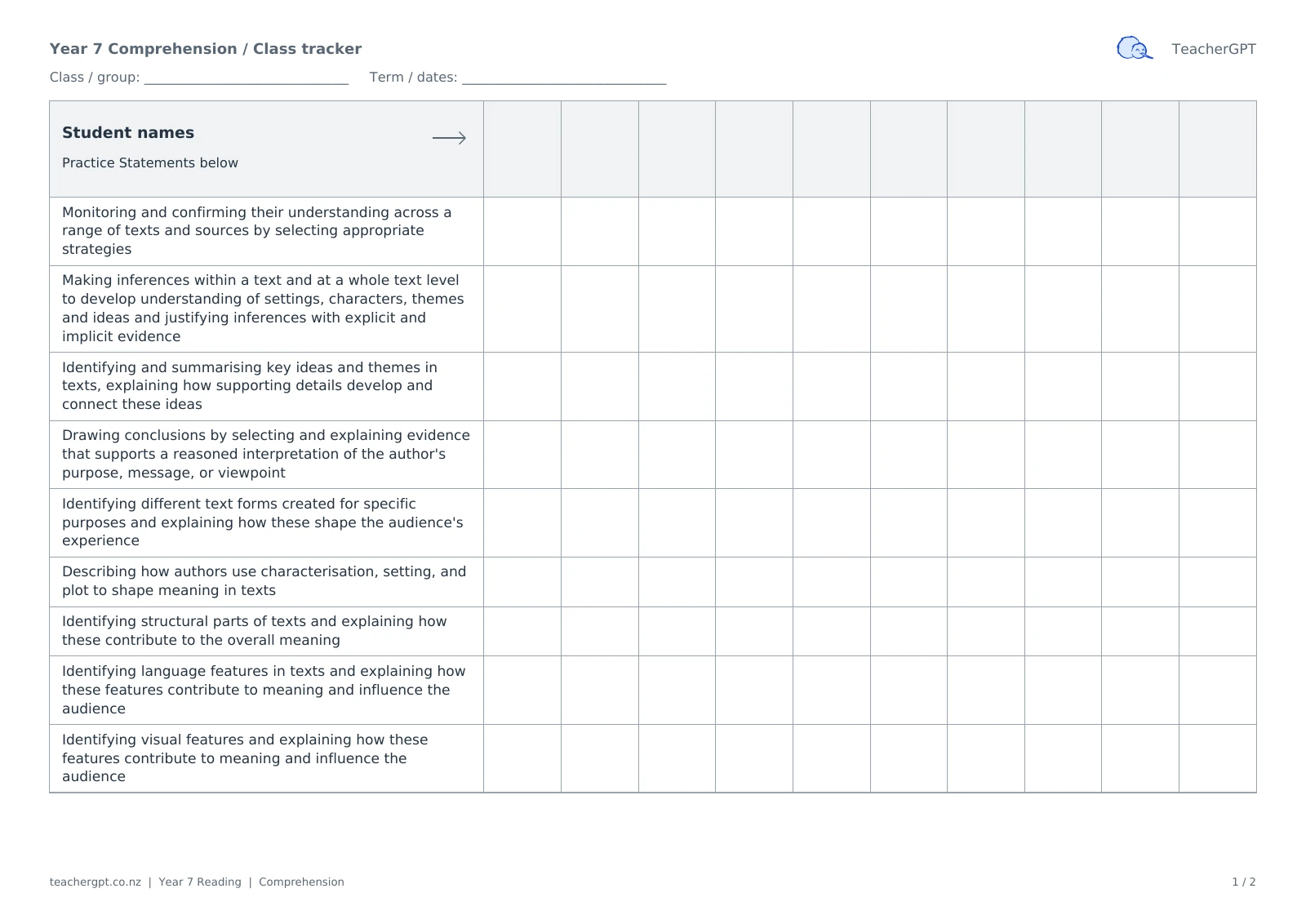
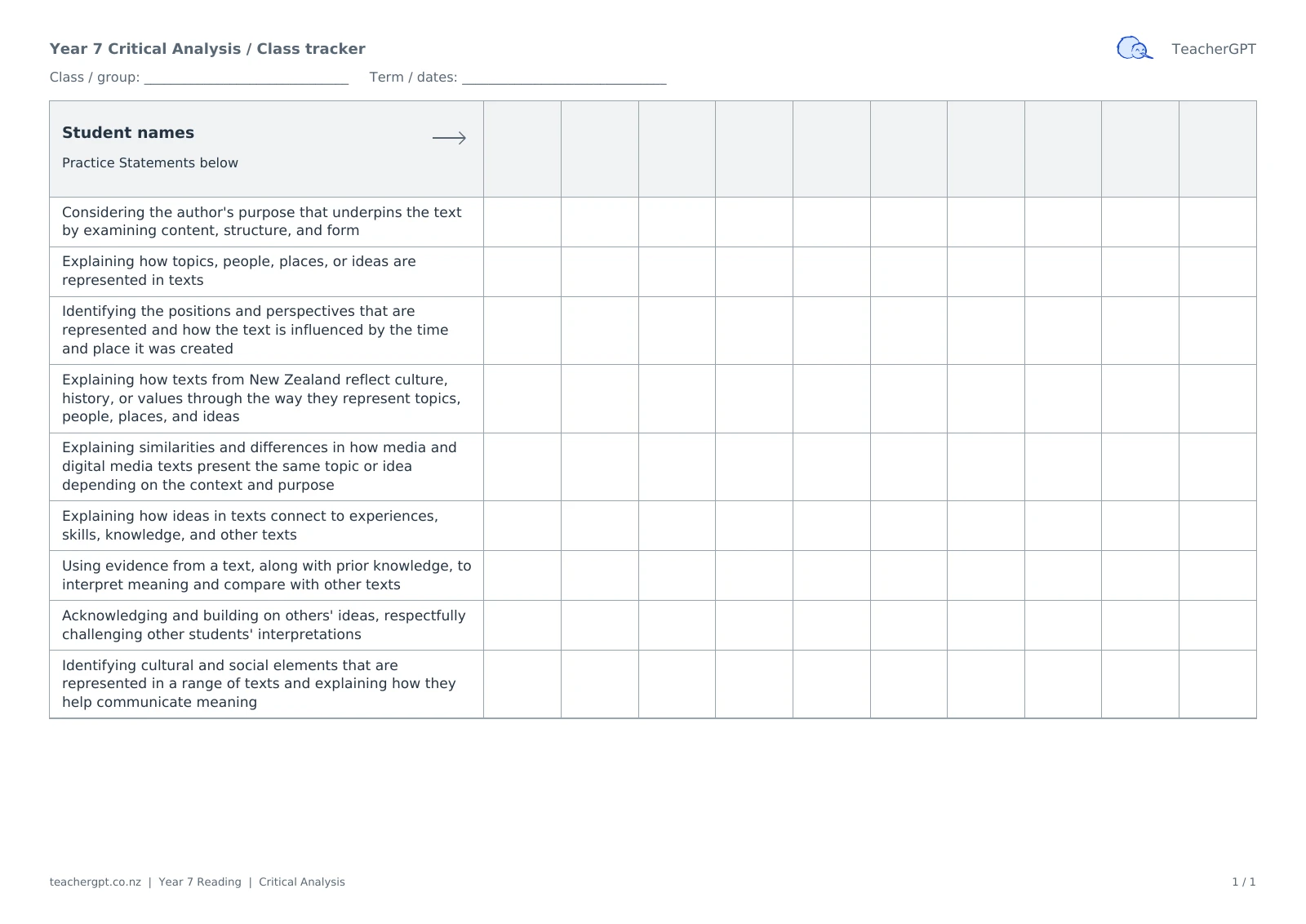
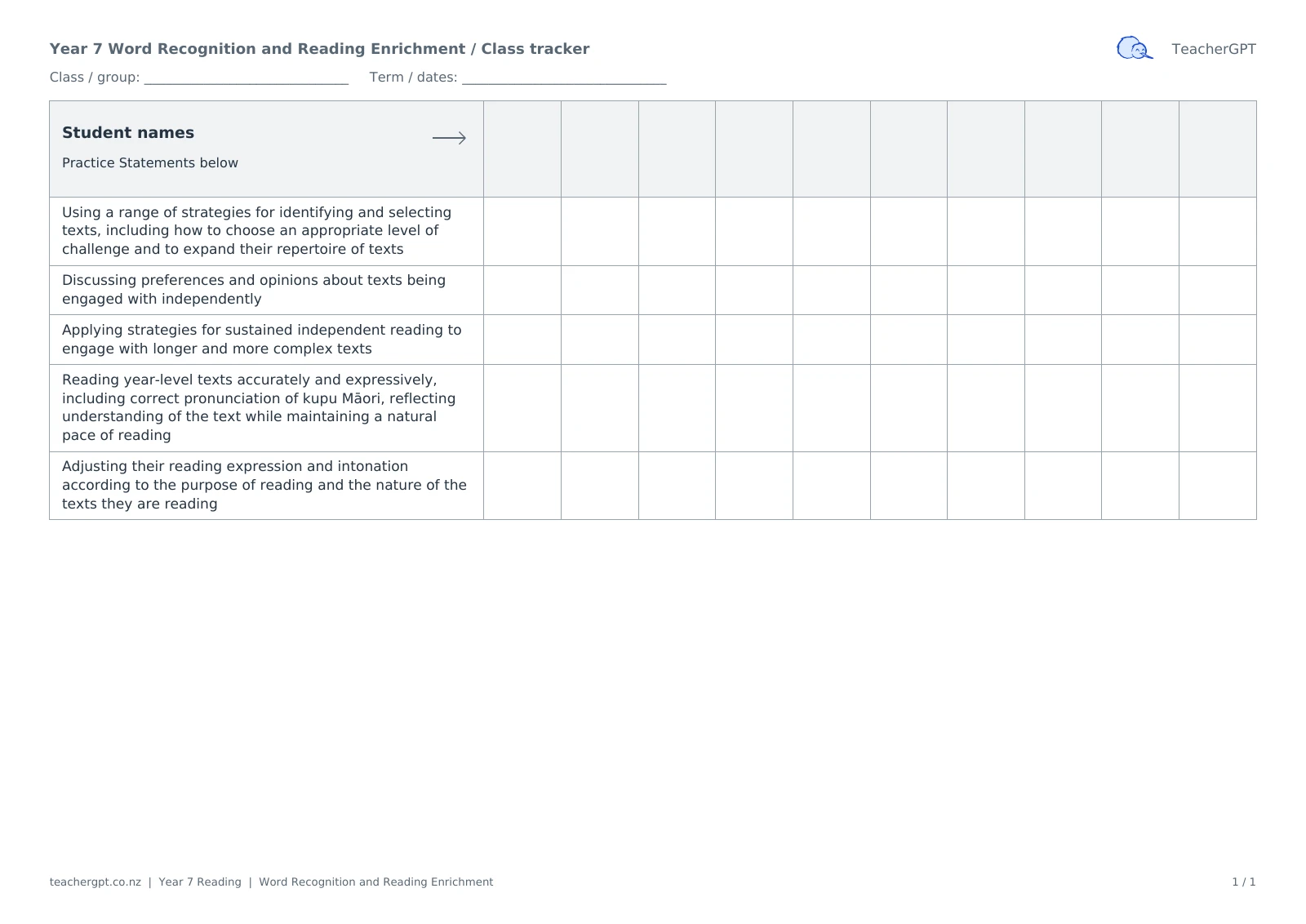
A simple tracker for your class. Practice Statements down the left, ten student-name spaces across the top, and blank cells to use your way.
Choose a strand below. Write in the names, then add your own ticks, dates, codes or notes. For a class of 25, print three copies of the tracker.
28 Practice Statements · 3 strands · PDF and Google Sheets · No TeacherGPT signup needed
Choose a tracker by strand
Each preview shows the first page of that PDF. Longer strands continue over several pages, with space for the same ten names on every page.
Prefer to work online? Choose Copy to Google Sheets to make your own editable copy in your Google account. The original is view-only. Add student names and notes to your own copy, and add more student columns if needed.
Comprehension
14 Practice Statements · 2 pages · 10 student columns
These trackers cover all 28 stored Year 7 Reading Practice Statements, organised into their curriculum strands and skill groups.
Comprehension
Comprehension strategies
Monitoring and confirming their understanding across a range of texts and sources by selecting appropriate strategies
Making inferences within a text and at a whole text level to develop understanding of settings, characters, themes and ideas and justifying inferences with explicit and implicit evidence
Identifying and summarising key ideas and themes in texts, explaining how supporting details develop and connect these ideas
Drawing conclusions by selecting and explaining evidence that supports a reasoned interpretation of the author's purpose, message, or viewpoint
Text form, structure, style, and features
Identifying different text forms created for specific purposes and explaining how these shape the audience's experience
Describing how authors use characterisation, setting, and plot to shape meaning in texts
Identifying structural parts of texts and explaining how these contribute to the overall meaning
Identifying language features in texts and explaining how these features contribute to meaning and influence the audience
Identifying visual features and explaining how these features contribute to meaning and influence the audience
Identifying and examining how specific features of digital media texts communicate messages and influence audience understanding and engagement
Vocabulary
Using a range of strategies to ascertain the meaning of academic and content-specific words and phrases in year-level texts
Identifying roots and affixes to determine meaning of unfamiliar words
Using year-appropriate academic and content-specific words and phrases with accuracy
Using print and digital dictionaries for pronunciation and definition, for both English and everyday te reo Māori
Critical Analysis
Context and purpose
Considering the author's purpose that underpins the text by examining content, structure, and form
Explaining how topics, people, places, or ideas are represented in texts
Identifying the positions and perspectives that are represented and how the text is influenced by the time and place it was created
Explaining how texts from New Zealand reflect culture, history, or values through the way they represent topics, people, places, and ideas
Explaining similarities and differences in how media and digital media texts present the same topic or idea depending on the context and purpose
Interpretations and connections
Explaining how ideas in texts connect to experiences, skills, knowledge, and other texts
Using evidence from a text, along with prior knowledge, to interpret meaning and compare with other texts
Acknowledging and building on others' ideas, respectfully challenging other students' interpretations
Identifying cultural and social elements that are represented in a range of texts and explaining how they help communicate meaning
Word Recognition and Reading Enrichment
Developing confident readers
Using a range of strategies for identifying and selecting texts, including how to choose an appropriate level of challenge and to expand their repertoire of texts
Discussing preferences and opinions about texts being engaged with independently
Applying strategies for sustained independent reading to engage with longer and more complex texts
Fluency
Reading year-level texts accurately and expressively, including correct pronunciation of kupu Māori, reflecting understanding of the text while maintaining a natural pace of reading
Adjusting their reading expression and intonation according to the purpose of reading and the nature of the texts they are reading