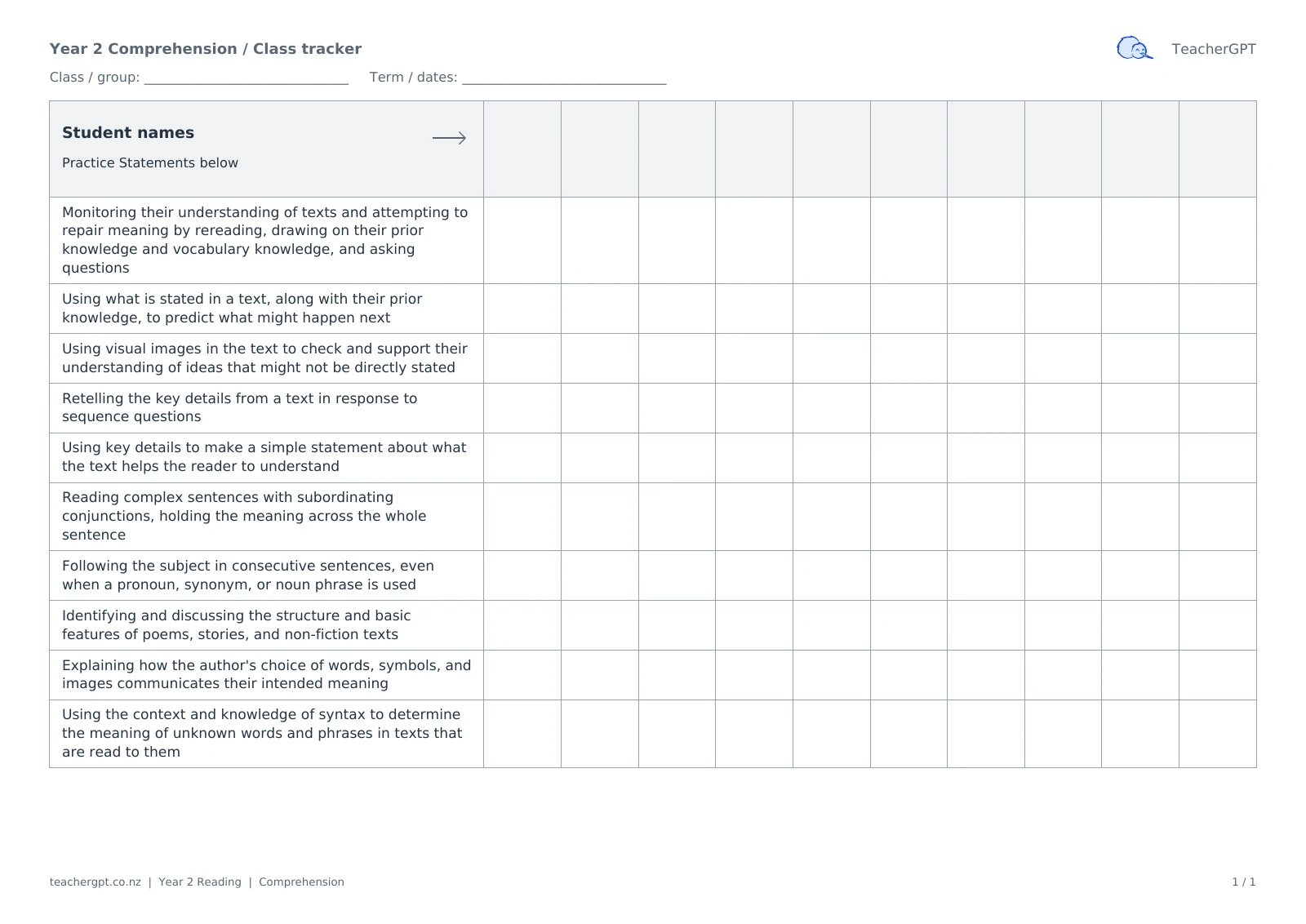
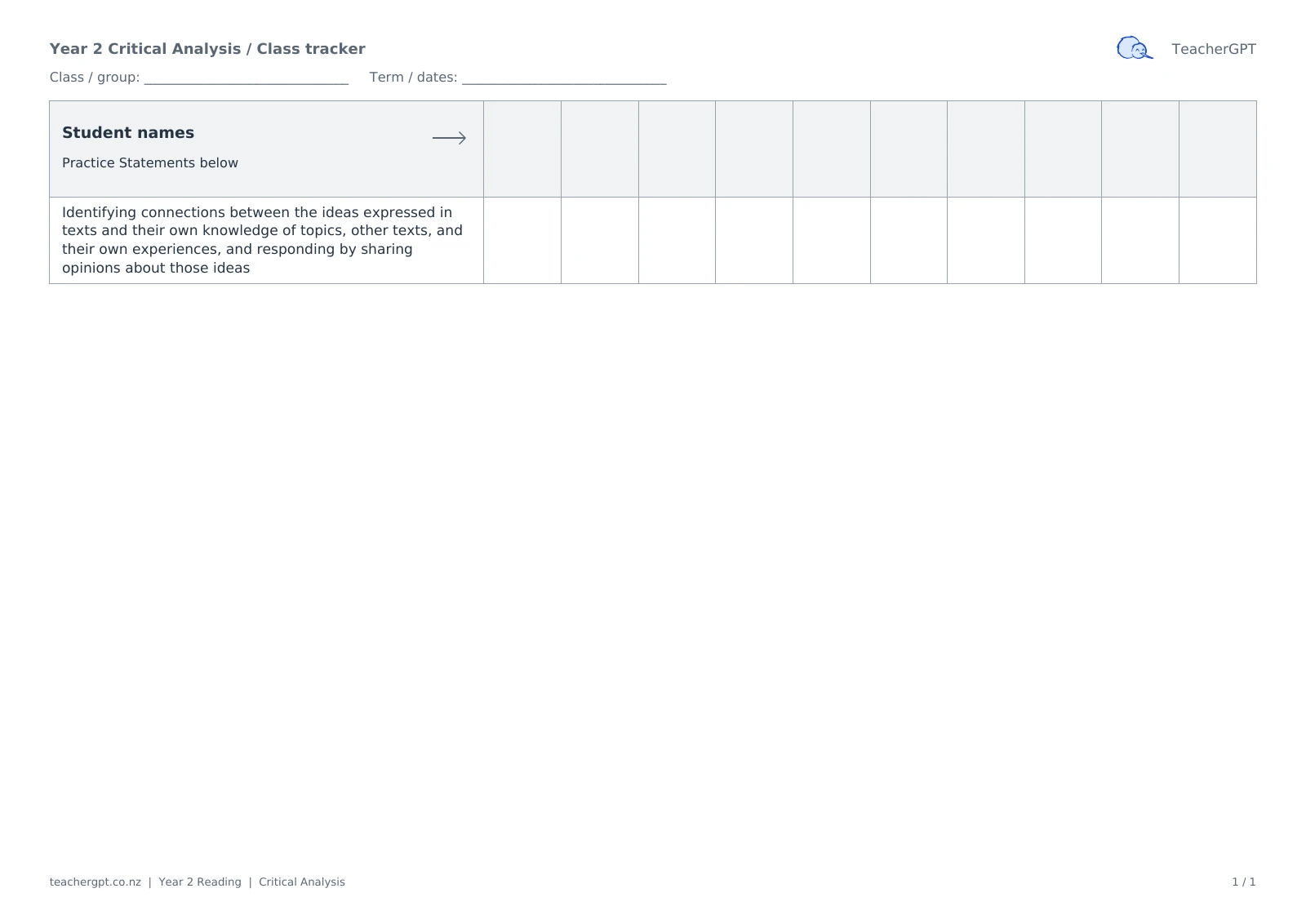
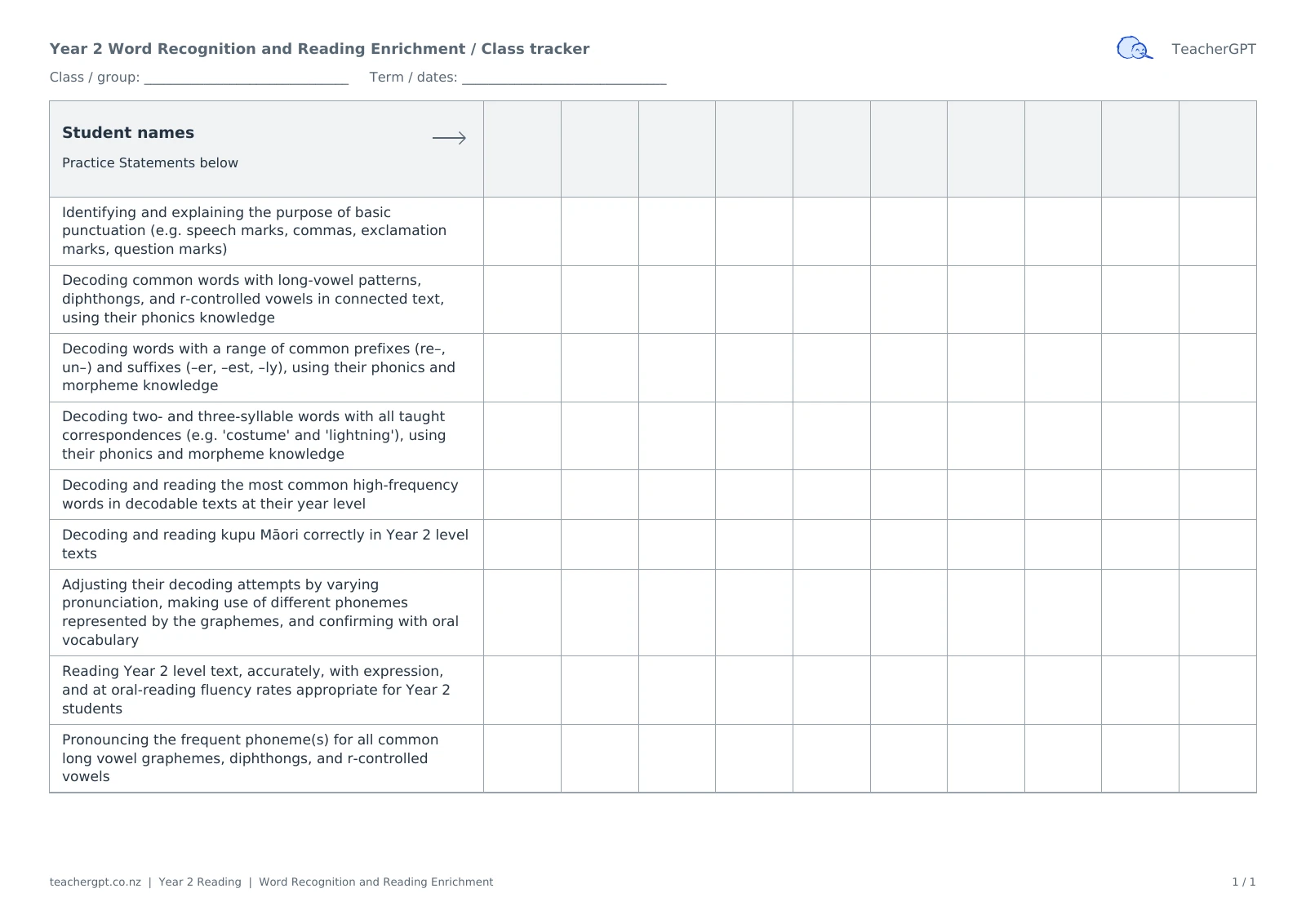
A simple tracker for your class. Practice Statements down the left, ten student-name spaces across the top, and blank cells to use your way.
Choose a strand below. Write in the names, then add your own ticks, dates, codes or notes. For a class of 25, print three copies of the tracker.
20 Practice Statements · 3 strands · PDF and Google Sheets · No TeacherGPT signup needed
Choose a tracker by strand
Each preview shows the first page of that PDF. Longer strands continue over several pages, with space for the same ten names on every page.
Prefer to work online? Choose Copy to Google Sheets to make your own editable copy in your Google account. The original is view-only. Add student names and notes to your own copy, and add more student columns if needed.
Comprehension
10 Practice Statements · 1 page · 10 student columns
These trackers cover all 20 stored Year 2 Reading Practice Statements, organised into their curriculum strands and skill groups.
Comprehension
Comprehension strategies
Monitoring their understanding of texts and attempting to repair meaning by rereading, drawing on their prior knowledge and vocabulary knowledge, and asking questions
Using what is stated in a text, along with their prior knowledge, to predict what might happen next
Using visual images in the text to check and support their understanding of ideas that might not be directly stated
Retelling the key details from a text in response to sequence questions
Using key details to make a simple statement about what the text helps the reader to understand
Sentence structure
Reading complex sentences with subordinating conjunctions, holding the meaning across the whole sentence
Following the subject in consecutive sentences, even when a pronoun, synonym, or noun phrase is used
Text form, structure, style, and features
Identifying and discussing the structure and basic features of poems, stories, and non-fiction texts
Explaining how the author's choice of words, symbols, and images communicates their intended meaning
Vocabulary
Using the context and knowledge of syntax to determine the meaning of unknown words and phrases in texts that are read to them
Critical Analysis
Interpretations and connections
Identifying connections between the ideas expressed in texts and their own knowledge of topics, other texts, and their own experiences, and responding by sharing opinions about those ideas
Word Recognition and Reading Enrichment
Conventions of print
Identifying and explaining the purpose of basic punctuation (e.g. speech marks, commas, exclamation marks, question marks)
Decoding
Decoding common words with long-vowel patterns, diphthongs, and r-controlled vowels in connected text, using their phonics knowledge
Decoding words with a range of common prefixes (re–, un–) and suffixes (–er, –est, –ly), using their phonics and morpheme knowledge
Decoding two- and three-syllable words with all taught correspondences (e.g. 'costume' and 'lightning'), using their phonics and morpheme knowledge
Decoding and reading the most common high-frequency words in decodable texts at their year level
Decoding and reading kupu Māori correctly in Year 2 level texts
Adjusting their decoding attempts by varying pronunciation, making use of different phonemes represented by the graphemes, and confirming with oral vocabulary
Fluency
Reading Year 2 level text, accurately, with expression, and at oral-reading fluency rates appropriate for Year 2 students
Phonemic awareness and phonics knowledge
Pronouncing the frequent phoneme(s) for all common long vowel graphemes, diphthongs, and r-controlled vowels