A simple tracker for your class. Practice Statements down the left, ten student-name spaces across the top, and blank cells to use your way.
Choose a strand below. Write in the names, then add your own ticks, dates, codes or notes. For a class of 25, print three copies of the tracker.
55 Practice Statements · 3 strands · PDF and Google Sheets · No TeacherGPT signup needed
Choose a tracker by strand
Each preview shows the first page of that PDF. Longer strands continue over several pages, with space for the same ten names on every page.
Prefer to work online? Choose Copy to Google Sheets to make your own editable copy in your Google account. The original is view-only. Add student names and notes to your own copy, and add more student columns if needed.
In Composition, Transcription Skills and Writing processes, each curriculum subcategory starts on a new page within its strand PDF. Longer subcategories continue under the same heading.
Composition
34 Practice Statements · 5 pages · 10 student columns
These trackers cover all 55 stored Year 6 Writing Practice Statements, organised into their curriculum strands and skill groups.
Composition
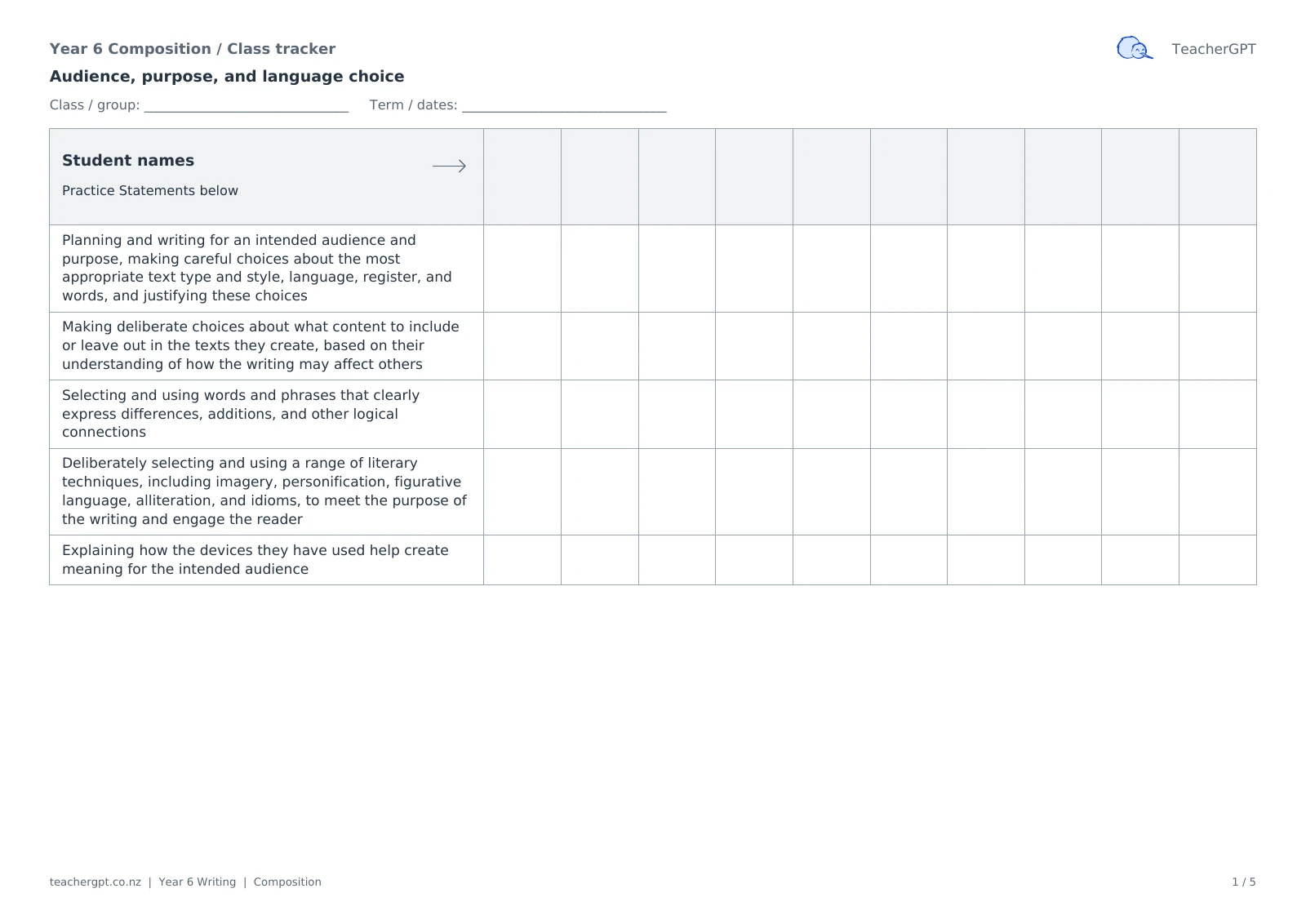
Audience, purpose, and language choice
Planning and writing for an intended audience and purpose, making careful choices about the most appropriate text type and style, language, register, and words, and justifying these choices
Making deliberate choices about what content to include or leave out in the texts they create, based on their understanding of how the writing may affect others
Selecting and using words and phrases that clearly express differences, additions, and other logical connections
Deliberately selecting and using a range of literary techniques, including imagery, personification, figurative language, alliteration, and idioms, to meet the purpose of the writing and engage the reader
Explaining how the devices they have used help create meaning for the intended audience
Sentence structures, grammar, and punctuation
Explaining the difference between a clause and an adverbial phrase and identifying these in a variety of sentence structures
Combining sentences orally to create a range of structures, choosing their preferred structure and justifying their choice
Using a range of sentence structures and types, rearranging the order of clauses and phrases for optimal effect
Expanding sentences using adverbial and adjectival phrases and appositives
Independently using commas correctly with independent clauses, adverbs and adverbial phrases, and appositives
Using speech marks, commas, and other associated punctuation correctly for direct speech, independently
Writing to entertain
Writing texts to entertain that reflect personal experiences and knowledge
Writing texts to entertain that contain narrative elements: character, setting, problem/purpose, plan, action, resolution
Writing texts to entertain that are well structured into paragraphs
Writing texts to entertain that develop the plot using transitional words or phrases
Writing texts to entertain that develop characters by including actions and feelings
Writing texts to entertain that may include shifts in time and several settings
Writing texts to entertain that include sensory details to build character and setting for effect
Writing texts to entertain that provide a sense of closure that ends the story effectively
Writing texts to entertain that include poetic language, devices, and structures
Writing to inform
Writing texts to inform that reflect personal experiences and knowledge
Writing texts to inform that introduce a topic clearly, and group related information logically into paragraphs
Writing texts to inform that include headings and visual features to support the meaning of their writing
Writing texts to inform that develop the topic with facts, definitions, details, and examples that support the main idea
Writing texts to inform that include precise language and domain-specific vocabulary
Writing texts to inform that begin to include words and phrases to clarify, illustrate, or compare ideas (e.g. 'especially', 'for example', 'in contrast')
Writing texts to inform that provide concluding sentences related to the information or explanation
Writing to persuade
Writing texts to persuade that reflect personal experiences and knowledge
Writing texts to persuade that introduce a topic and clearly state a position taken on it
Writing texts to persuade that organise writing into three or more paragraphs that have logically grouped ideas
Writing texts to persuade that order ideas/paragraphs that are supported by facts/details from strongest to weakest
Writing texts to persuade that include emotive words and phrases to persuade the reader to adopt their position
Writing texts to persuade that include a range of linking words (e.g. 'consequently', 'specifically') to link the opinion and reasons
Writing texts to persuade that provide a concluding paragraph related to the position taken on the topic
Transcription Skills
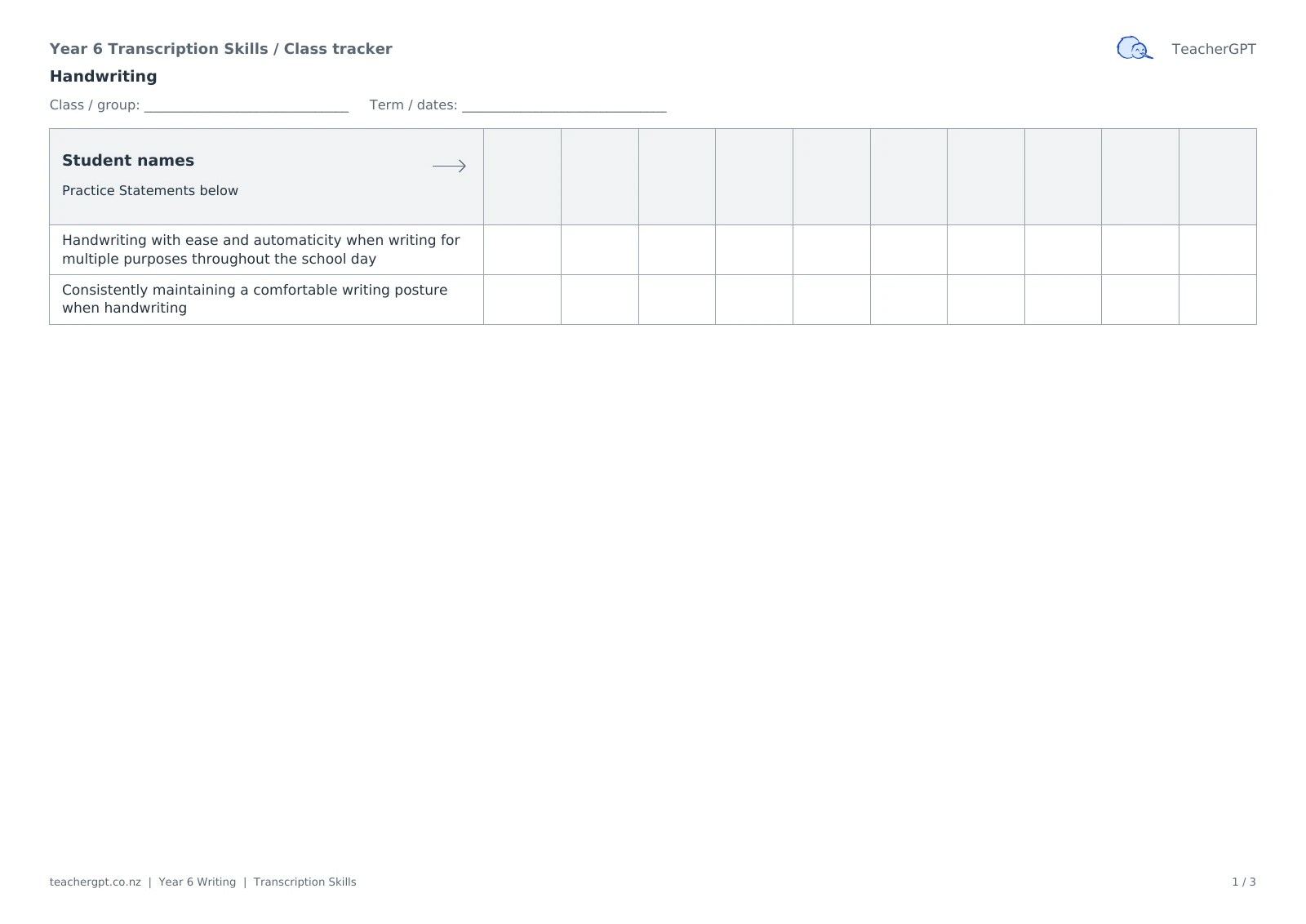
Handwriting
Handwriting with ease and automaticity when writing for multiple purposes throughout the school day
Consistently maintaining a comfortable writing posture when handwriting
Keyboarding
Using efficient keyboarding to develop speed and accuracy
Consistently maintaining a comfortable writing posture when using a keyboard
Spelling
Spelling words with less-common vowel and consonant graphemes (e.g. <ough>, <eigh>, <aigh>, <augh>, <kn>, <mb>, <sc> as /s/, <wr> as /r/), noting the unusual correspondences and where these occur in the word
Using the three different spellings for the /air/ phoneme: <air>, <are>, <ear>
Spelling words with prefixes indicating number (e.g. uni–, bi–, tri–, dec–) and suffixes that change words into a noun (e.g. –logy, –ism, –ment) and demonstrating understanding of their meanings
Spelling words with apostrophes to show possession
Spelling plurals of words ending in 'f' or 'fe' by changing the 'f' or 'fe' to 'ves' (e.g. 'leaf' ➝ 'leaves', 'knife' ➝ 'knives')
Writing processes
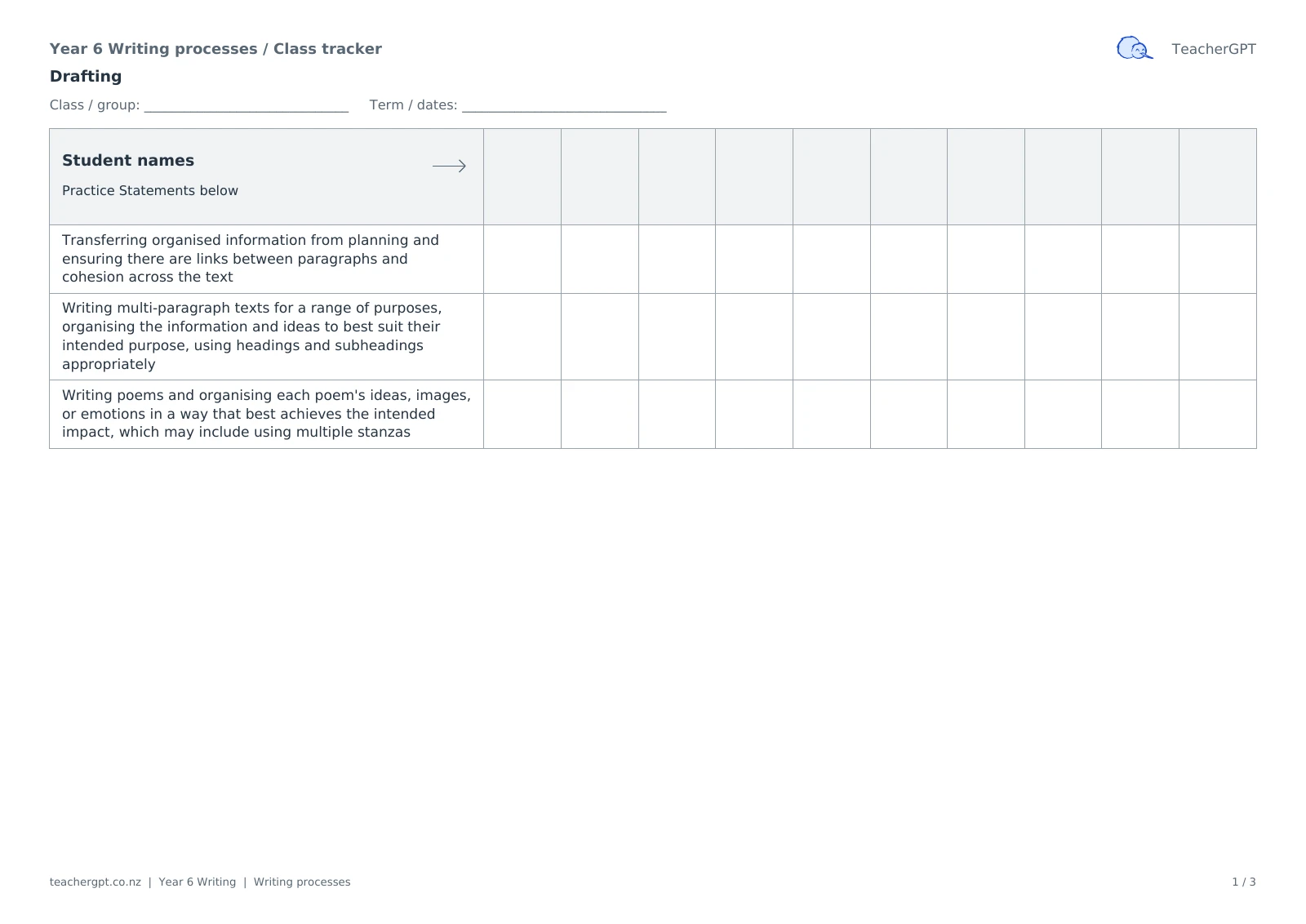
Drafting
Transferring organised information from planning and ensuring there are links between paragraphs and cohesion across the text
Writing multi-paragraph texts for a range of purposes, organising the information and ideas to best suit their intended purpose, using headings and subheadings appropriately
Writing poems and organising each poem's ideas, images, or emotions in a way that best achieves the intended impact, which may include using multiple stanzas
Planning
Choosing and using the most appropriate graphic organiser or mnemonic for the writing task
Making notes by gathering key information from a range of print and digital sources and organising it into categories
Setting and working towards specific writing goals based on reflection on their own writing content and processes
Revising and editing
Independently reading and checking continuously while writing, throughout the school day across all learning areas
Making revisions at the word, sentence, and text structure levels, with the purpose and audience in mind
Noticing errors in grammar and meaning and independently making corrections as they write
Making edits to improve the clarity of a range of texts using known punctuation and layout conventions
Using a physical or online dictionary to find or confirm the spellings of unknown words
Selectively accepting or rejecting audience and peer feedback and justifying their decision