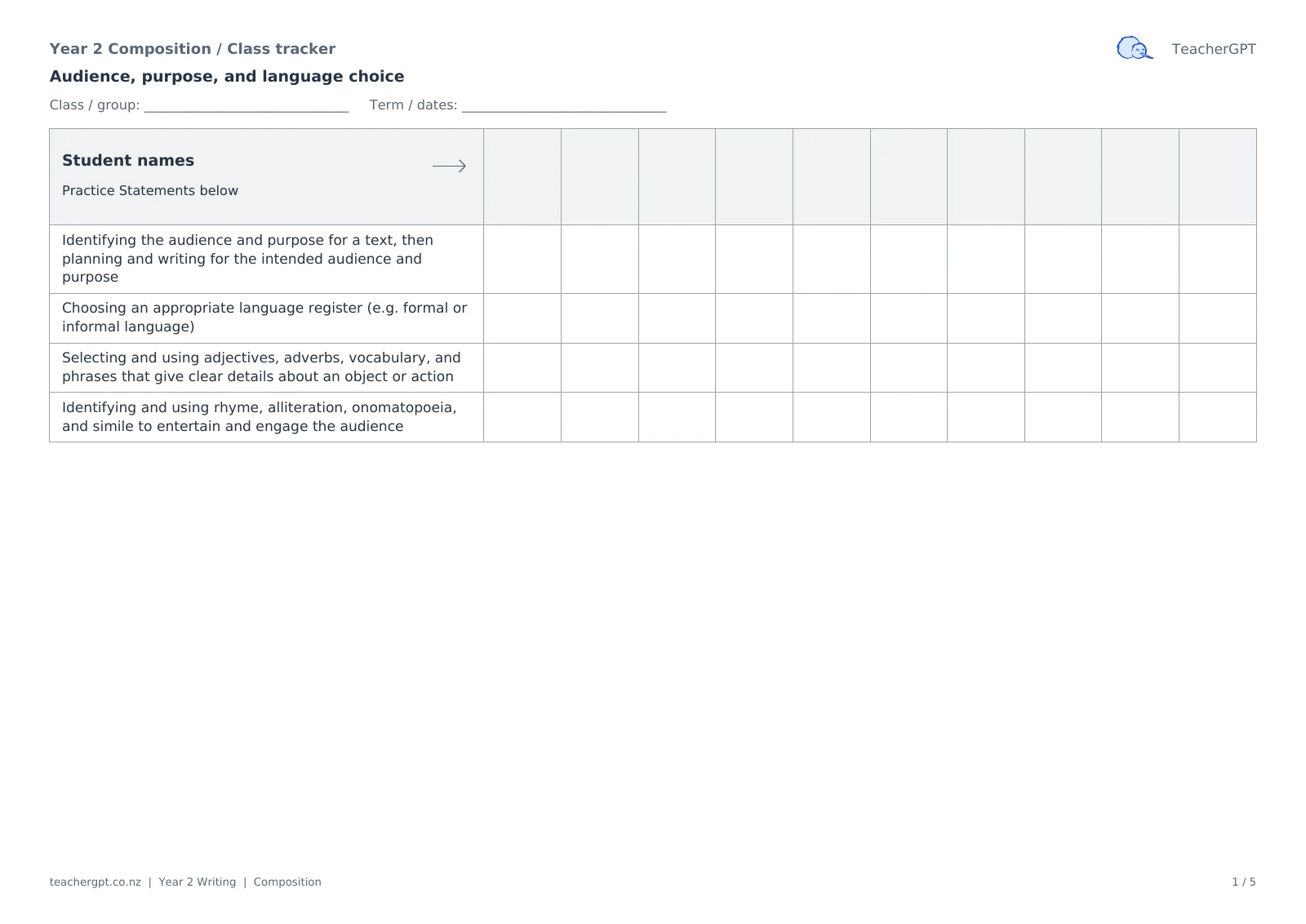
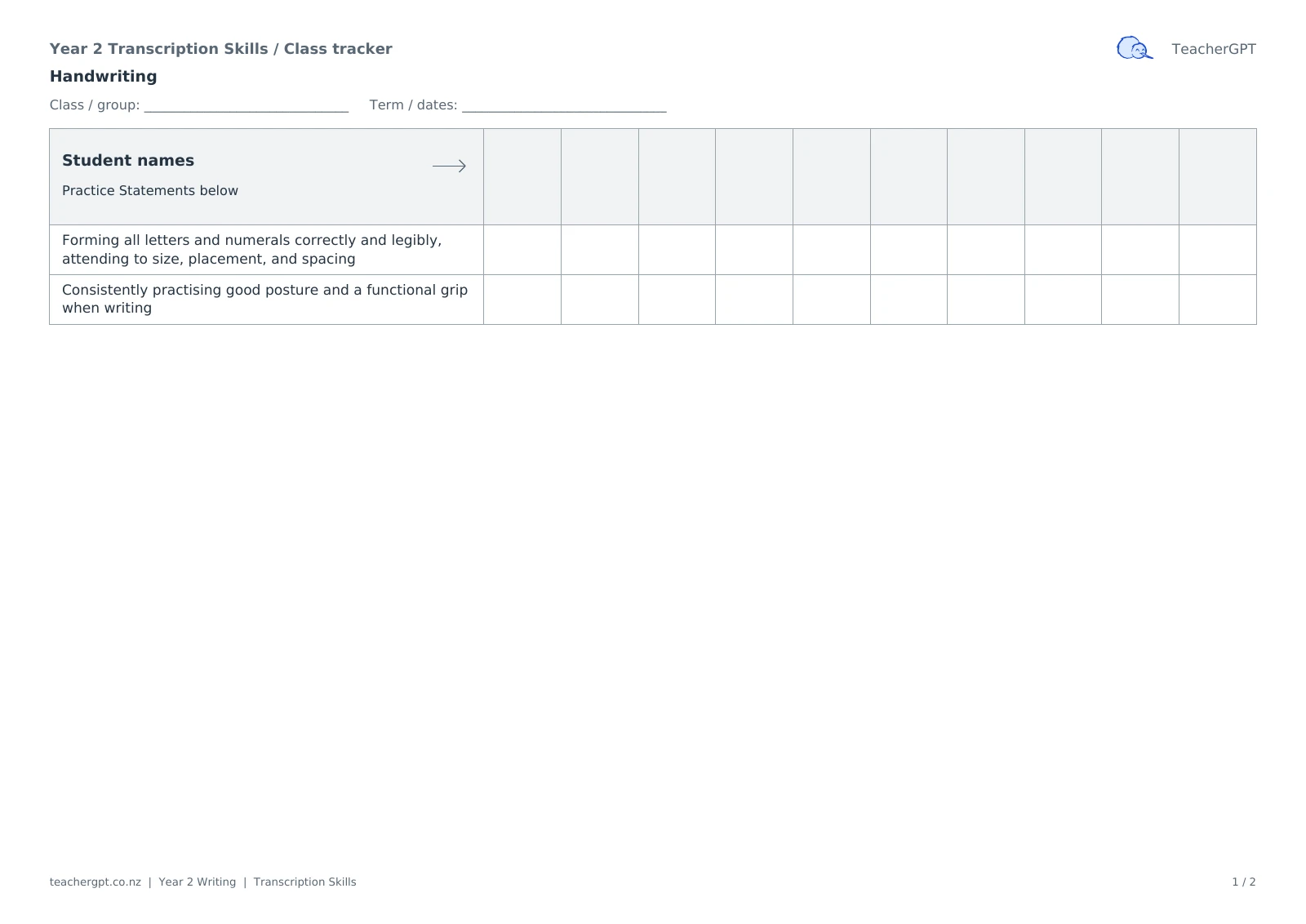
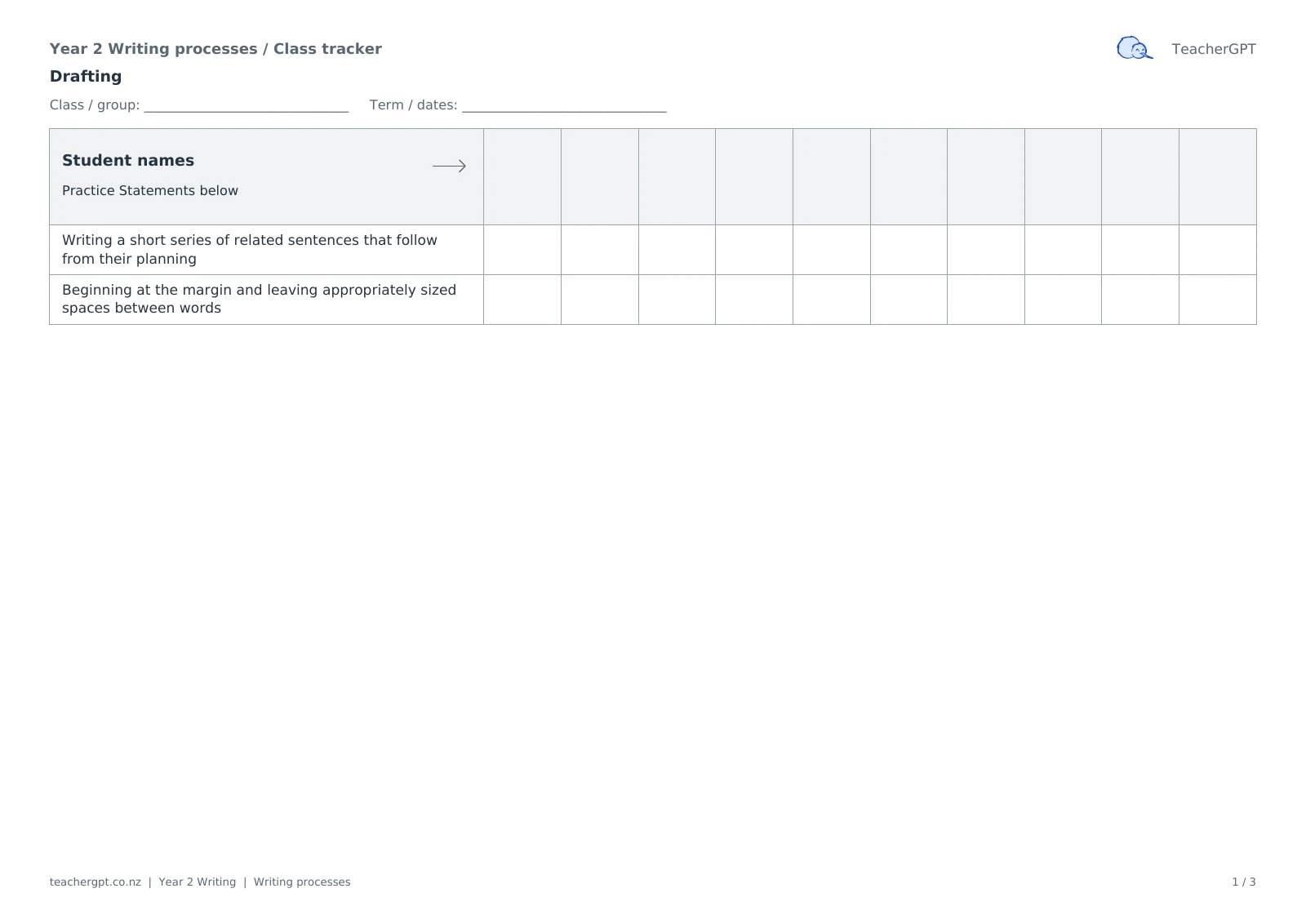
A simple tracker for your class. Practice Statements down the left, ten student-name spaces across the top, and blank cells to use your way.
Choose a strand below. Write in the names, then add your own ticks, dates, codes or notes. For a class of 25, print three copies of the tracker.
25 Practice Statements · 3 strands · PDF and Google Sheets · No TeacherGPT signup needed
Choose a tracker by strand
Each preview shows the first page of that PDF. Longer strands continue over several pages, with space for the same ten names on every page.
Prefer to work online? Choose Copy to Google Sheets to make your own editable copy in your Google account. The original is view-only. Add student names and notes to your own copy, and add more student columns if needed.
In Composition, Transcription Skills and Writing processes, each curriculum subcategory starts on a new page within its strand PDF. Longer subcategories continue under the same heading.
Composition
10 Practice Statements · 5 pages · 10 student columns
These trackers cover all 25 stored Year 2 Writing Practice Statements, organised into their curriculum strands and skill groups.
Composition
Audience, purpose, and language choice
Identifying the audience and purpose for a text, then planning and writing for the intended audience and purpose
Choosing an appropriate language register (e.g. formal or informal language)
Selecting and using adjectives, adverbs, vocabulary, and phrases that give clear details about an object or action
Identifying and using rhyme, alliteration, onomatopoeia, and simile to entertain and engage the audience
Sentence structures, grammar, and punctuation
Combining two simple sentences orally, using a coordinating conjunction, to form a compound sentence
Using compound sentences with coordinating conjunctions in writing
Using full stops and capital letters correctly and independently
Writing to entertain
Writing short narratives about two or more sequenced events, including some details regarding what happened and where, and providing some sense of closure
Writing to inform
Writing a series of sentences about a topic, including a main idea and some related details
Writing to persuade
Writing a series of sentences in which they state their opinion about a topic, followed by a reason for the opinion
Transcription Skills
Handwriting
Forming all letters and numerals correctly and legibly, attending to size, placement, and spacing
Consistently practising good posture and a functional grip when writing
Spelling
Orally segmenting two-syllable words into syllables, then segmenting syllables into phonemes for spelling
Identifying and recording phonemes in words, including: all short-vowel sounds; all single-letter consonant sounds; consonant sounds spelt with double letters (e.g. ff, ss); consonant sounds spelt with digraphs and trigraphs (e.g. –dge, –tch); two or three adjacent consonant sounds (CCCVC, CCCVCC)
Spelling words with the vowel patterns: <a_e>, <ai>, and <ay> representing /long a/; <e_e> representing /long e/; <i_e> representing /long i/; <o_e> representing /long o/; <u_e> representing /long u/; <ou> and <ow> representing /ow/; <oo> as in 'good'; <oy> and <oi> as in 'coin' and 'toy'; <ee> and <ea> representing /long e/; <oa> and <ow> representing /long o/
Spelling words with r-controlled vowels represented by <ar>, <or>, <er>, <ir>, and <ur>
Spelling 20 or more words that are high frequency in their oral vocabulary and contain irregular or currently untaught phoneme–grapheme correspondences
Adding common suffixes
Writing processes
Drafting
Writing a short series of related sentences that follow from their planning
Beginning at the margin and leaving appropriately sized spaces between words
Planning
Planning a short series of sentences through talk, thinking carefully about each sentence before writing it
Identifying and working towards a specific writing goal
Revising and editing
Rereading to check each sentence and making corrections when something does not make sense
Adding or deleting words to clarify meaning, using feedback from teachers
Making simple edits to draft sentences, using known spelling patterns, capital letters, and punctuation to indicate the end of a sentence